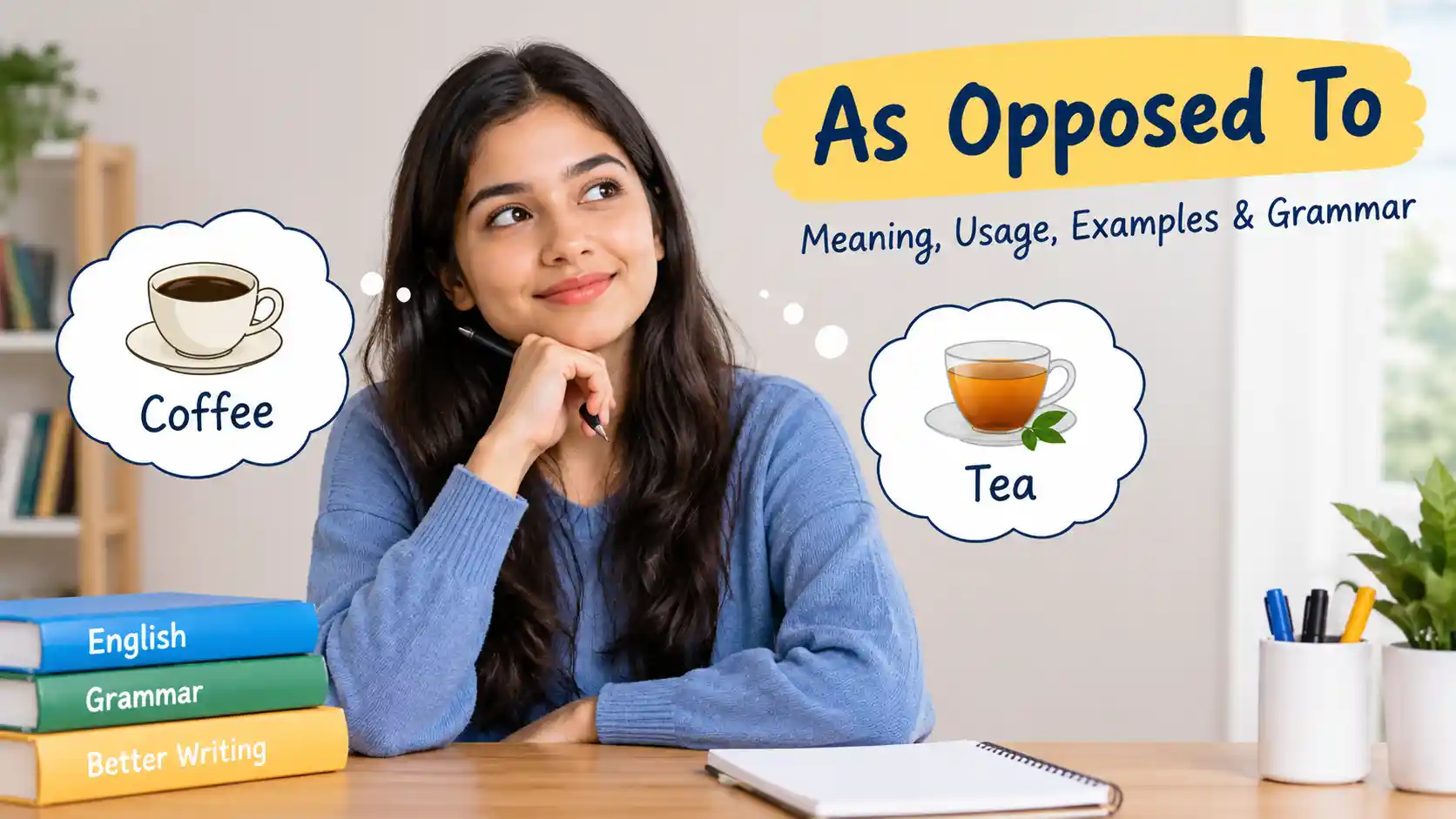
When you see the phrase as opposed to, it usually means rather than or in contrast with. We use it when we want to compare two people, things, ideas, or choices and show that one is different from the other.
For example, She chose tea as opposed to coffee means she chose tea rather than coffee. This guide explains the as opposed to meaning, how to use it correctly, common mistakes, and many simple examples.
Quick Answer: What Does As Opposed To Mean?
The phrase as opposed to means rather than or in contrast to. It is used to point out a difference between two things.
For example:
I prefer walking as opposed to driving.
This means:
I prefer walking rather than driving.
The phrase can describe a simple choice, but it can also show a clear difference between two ideas.
Here are a few quick examples:
| Sentence | Simple meaning |
| He drinks water as opposed to soda. | He drinks water rather than soda. |
| She works from home as opposed to the office. | She works from home instead of the office. |
| The class focuses on writing as opposed to memorizing. | The class focuses on writing rather than memorizing. |
| This is a fact as opposed to an opinion. | This is a fact, not an opinion. |
The exact meaning depends on the sentence, but the basic idea is always comparison or contrast.
As Opposed To Meaning and Definition

The as opposed to meaning is easiest to understand when you think about comparison.
The word opposed can mean being different from or against something. In the phrase as opposed to, however, it does not always mean that two things are strongly against each other.
Instead, it often simply tells the reader that two things are being compared.
For example:
He likes working alone as opposed to working in a group.
The sentence compares working alone with working in a group.
Another example is:
We need facts as opposed to guesses.
Here, the speaker wants facts rather than guesses.
The phrase can therefore have slightly different shades of meaning:
| Meaning | Example | Simple explanation |
| Rather than | I chose tea as opposed to coffee. | Tea was chosen instead of coffee. |
| In contrast with | She is quiet as opposed to her brother. | She is different from her brother. |
| Instead of | They used email as opposed to letters. | They used email instead of letters. |
| Compared with | The new model is smaller as opposed to the old one. | The two models are being contrasted. |
In everyday English, rather than is often a simpler replacement.
How to Use As Opposed To Correctly
As opposed to normally comes between two things that are being compared.
The two things can be nouns, noun phrases, verbs, or ideas.
For example:
We chose the blue car as opposed to the red car.
Here, blue car and red car are being compared.
You can also compare actions:
She prefers reading as opposed to watching TV.
The two activities are reading and watching TV.
You can compare ideas:
The article explains facts as opposed to rumors.
And you can compare situations:
They decided to stay home as opposed to going out.
A useful pattern is:
A + as opposed to + B
For example:
He likes working alone as opposed to working with others.
The phrase makes the contrast clear without needing a separate sentence.
As Opposed To vs. Rather Than
As opposed to and rather than are often interchangeable, but they do not always sound exactly the same.
Rather than is usually shorter and more natural in casual conversation. As opposed to can sound more formal or more focused on comparison.
Compare these sentences:
I walked rather than drove.
I walked as opposed to driving.
Both communicate a similar idea, but the first is more direct.
| Phrase | Basic meaning | Common feeling |
| As opposed to | In contrast with / rather than | More formal or explanatory |
| Rather than | Instead of | Natural and direct |
| Instead of | In place of | Very common and simple |
| Unlike | Different from | Strong focus on difference |
For everyday writing, choose the phrase that sounds natural in context. You do not need to use as opposed to just because it sounds formal.
As Opposed To vs. Instead Of
Another common comparison is as opposed to and instead of.
Both can show that one choice is different from another.
For example:
She bought fruit as opposed to candy.
This can become:
She bought fruit instead of candy.
The second sentence is shorter.
However, as opposed to can put more attention on the contrast.
Consider:
The study uses evidence as opposed to personal opinions.
The writer is not simply saying one thing replaced another. The writer is highlighting the difference between evidence and personal opinions.
That makes as opposed to useful in explanations, essays, reports, and comparisons.
Grammar: What Comes After As Opposed To?
A noun or noun phrase can follow as opposed to.
For example:
We chose the train as opposed to the bus.
It can also be followed by an activity ending in -ing:
He prefers cooking as opposed to eating out.
When comparing actions, it is often helpful to keep the grammar parallel.
For example:
She enjoys reading as opposed to watching television.
Both sides describe activities.
Another example:
They decided to save money as opposed to spending it.
The two actions are easy to compare.
The goal is simple: make the two parts of the comparison fit together naturally.
Real-Life Examples of As Opposed To
The phrase appears in many everyday situations.
At school, you might hear:
The teacher wants students to understand the idea as opposed to memorizing it.
At work:
We use video meetings as opposed to long email chains.
While shopping:
I bought the smaller package as opposed to the larger one.
When talking about food:
He ordered water as opposed to soda.
When discussing transportation:
We took the train as opposed to driving.
When discussing opinions:
She gave evidence as opposed to making a guess.
These examples show that the phrase works in both casual and formal contexts.
As Opposed To in Formal Writing

As opposed to is common in formal writing because it clearly shows a contrast.
You may see it in business reports, academic writing, news articles, instructions, and explanations.
For example:
The program focuses on prevention as opposed to treatment.
Or:
The research examines long-term effects as opposed to short-term changes.
It can make a comparison clear, but it should not be added simply to make writing sound more professional.
Compare:
The company chose online advertising rather than print advertising.
with:
The company chose online advertising as opposed to print advertising.
Both are correct. The first is more direct. The second puts more emphasis on the contrast.
Good writing is not about using the longest phrase. It is about choosing the phrase that communicates your idea clearly.
Common Mistakes With As Opposed To
One common mistake is using the phrase when there is no real comparison.
For example:
I went to the store as opposed to yesterday.
This sounds incorrect because the store and yesterday are not comparable choices.
A better sentence might be:
I went to the store today as opposed to yesterday.
Now the comparison is between today and yesterday.
Another mistake is creating an awkward comparison:
She likes reading as opposed to books.
This does not compare matching ideas. Reading is an activity, while books are things.
A clearer sentence is:
She likes reading as opposed to watching TV.
You should also avoid using the phrase too often in the same paragraph. Repetition can make your writing feel heavy.
| Common problem | Better approach |
| No clear comparison | Compare two related things. |
| Unequal grammar | Keep the two parts parallel when possible. |
| Too much formality | Use rather than or instead of when simpler. |
| Repeated use | Vary your wording naturally. |
| Confusing sentence | Rewrite the sentence in simpler English. |
Is As Opposed To Formal or Informal?
As opposed to is generally neutral to formal. It is perfectly acceptable in everyday English, but people often choose simpler alternatives in casual speech.
For example, a friend might say:
I want tea instead of coffee.
A report might say:
The study focuses on prevention as opposed to treatment.
Neither version is wrong.
The best choice depends on your audience and purpose. If you are writing for children or using very simple English, instead of or rather than may be easier to understand.
Is As Opposed To the Same as Opposed?
Not exactly.
The word opposed by itself can mean that someone disagrees with or resists something.
For example:
They are opposed to the new rule.
This means they do not support the new rule.
But as opposed to usually has a comparison meaning.
For example:
We chose a small house as opposed to a large house.
Here, there is no need for anyone to dislike the large house. The phrase simply contrasts the two choices.
This difference is important because the word opposed can suggest disagreement, while as opposed to often simply means rather than or in contrast with.
British vs. American English

The phrase as opposed to is used in both American and British English.
There is no major difference in its basic meaning.
For example, an American speaker might say:
She works remotely as opposed to working in an office.
A British speaker can use the same construction with the same meaning.
The phrase is therefore not limited to one variety of English.
When Should You Use As Opposed To?
Use as opposed to when you want to make a contrast clear.
It works especially well when the comparison is important to the meaning of the sentence.
For example:
The course teaches practical skills as opposed to only theory.
The contrast between practical skills and theory matters.
You may also use it when explaining two choices:
We selected the cheaper option as opposed to the more expensive one.
But if the sentence becomes long or complicated, a simpler phrase may be better.
Instead of:
The team decided to use the older system as opposed to the newer system because of several different reasons.
You could write:
The team chose the older system rather than the newer one.
Clear writing is usually better than unnecessarily formal writing.
Simple Synonyms for As Opposed To
Several phrases can replace as opposed to, depending on the sentence.
The most useful are rather than, instead of, unlike, in contrast to, and as compared with.
However, these phrases are not always exact replacements.
| Alternative | Example | Best use |
| Rather than | She walked rather than drove. | Showing a choice |
| Instead of | He drank water instead of soda. | Showing replacement |
| Unlike | Unlike his brother, he is quiet. | Showing difference |
| In contrast to | In contrast to last year, sales increased. | Strong comparison |
| Compared with | Compared with the old model, this is smaller. | Direct comparison |
Choosing the right synonym can make your sentence sound more natural.
Frequently Asked Questions
What is the simple meaning of as opposed to?
As opposed to means rather than, instead of, or in contrast to. It is used to compare two different things, choices, or ideas.
Is as opposed to grammatically correct?
Yes. As opposed to is a standard English phrase. It is commonly used to show a contrast between two things.
Can I use rather than instead of as opposed to?
Yes. In many sentences, rather than works as a simpler alternative. For example, She walked rather than drove has a similar meaning to She walked as opposed to driving.
Does as opposed to mean against?
Not always. In this phrase, it usually means in contrast to or rather than. The word opposed by itself can mean against, but the full phrase has a different common use.
Is as opposed to formal?
It is generally neutral to formal. It can be used in everyday conversation, but instead of and rather than may sound more natural in casual speech.
What is an easy example of as opposed to?
A simple example is: I chose water as opposed to soda. This means, I chose water rather than soda.
Conclusion
The as opposed to meaning is simple: it usually means rather than, instead of, or in contrast to. The phrase helps you compare two choices, ideas, people, actions, or things.
For example, She chose tea as opposed to coffee tells us that tea was chosen rather than coffee.
As opposed to can be useful in both everyday and formal English. Still, you should not use it just to make a sentence sound more advanced.
If instead of or rather than makes your meaning clearer, use the simpler option. The most important rule is to make the comparison easy for the reader to understand.

Ali Sher is a writer and the creator of Factnora.com, a website dedicated to sharing fascinating facts, biographies, history, and useful knowledge. He enjoys researching interesting topics and turning them into simple, engaging stories for readers. Through factnora, Muhammad aims to provide informative content that is easy to understand, enjoyable to read, and worth sharing.