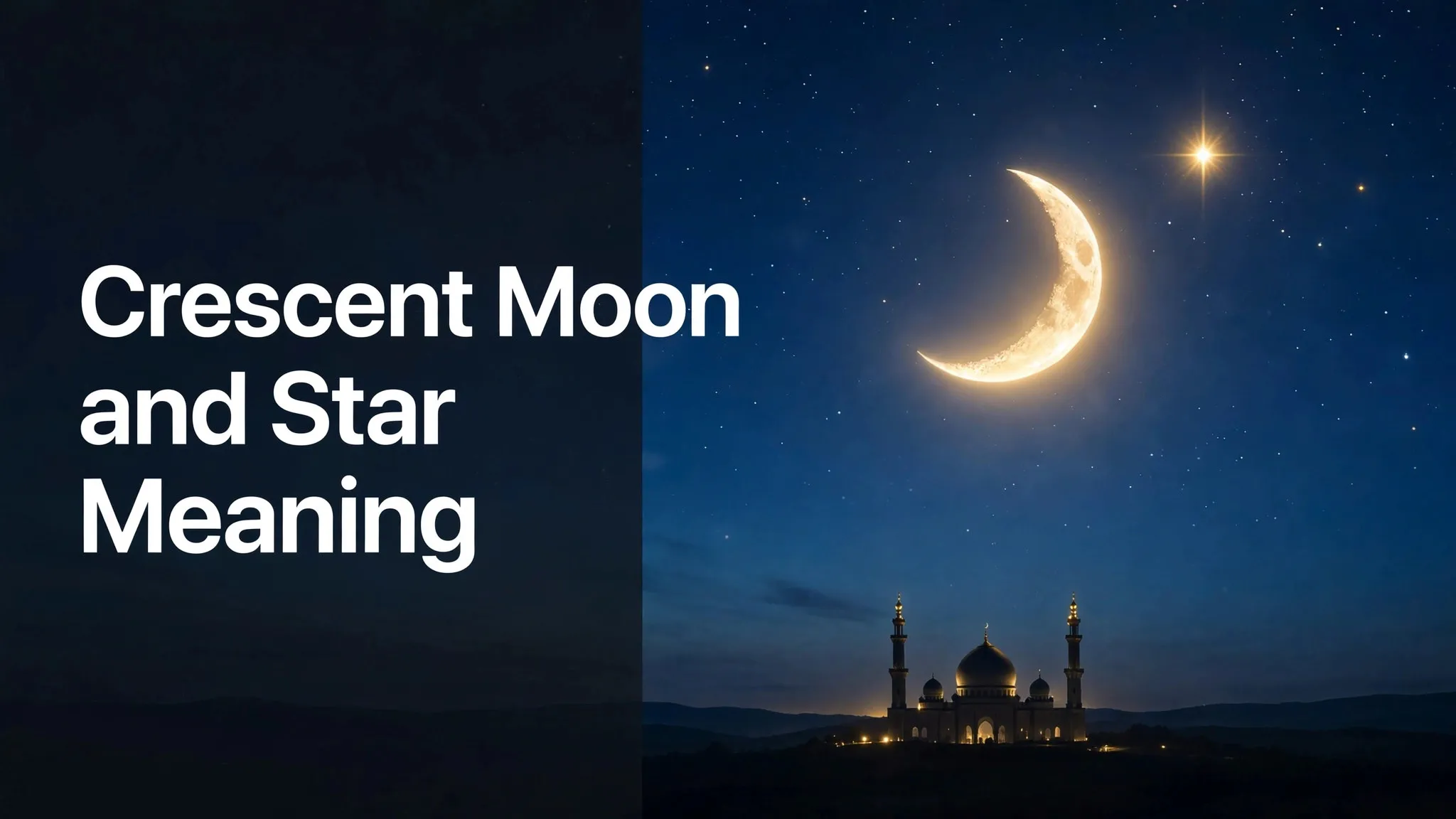
The crescent moon and star meaning is often connected with Islam, faith, guidance, hope, and the night sky.
However, the symbol has a longer and more complex history. It was used in different cultures before becoming strongly linked with Muslim societies.
Today, people may see the crescent and star on flags, mosques, jewelry, art, clothing, and social media. Its meaning can also change based on the culture and setting.
In this guide, we will explain what the crescent moon and star can mean, how the symbol became connected with Islam, what it may represent spiritually, and why it remains popular today.
Quick Answer: What Does the Crescent Moon and Star Mean?
The crescent moon and star commonly represent Islam, Muslim identity, faith, and the importance of the lunar calendar. The crescent can also suggest change, renewal, hope, and the beginning of a new phase.
It is important to know that the crescent and star is not an official symbol of Islam in the same way that a cross is commonly associated with Christianity. The Qur’an does not establish the crescent and star as a religious emblem.
Instead, the symbol became closely connected with Muslim cultures over many centuries. Its modern association with Islam grew through history, especially through the Ottoman Empire and later through national flags and other forms of public symbolism.
The meaning can therefore depend on where and how the symbol is used.
| Symbol | Common meaning |
| Crescent moon | Renewal, change, the lunar calendar, hope |
| Star | Light, guidance, knowledge, direction |
| Crescent and star together | Muslim identity, faith, culture, tradition |
| New moon | Beginning of a new lunar month |
| Night sky | Reflection, mystery, peace, and creation |
What Is the Crescent Moon and Star Symbol?
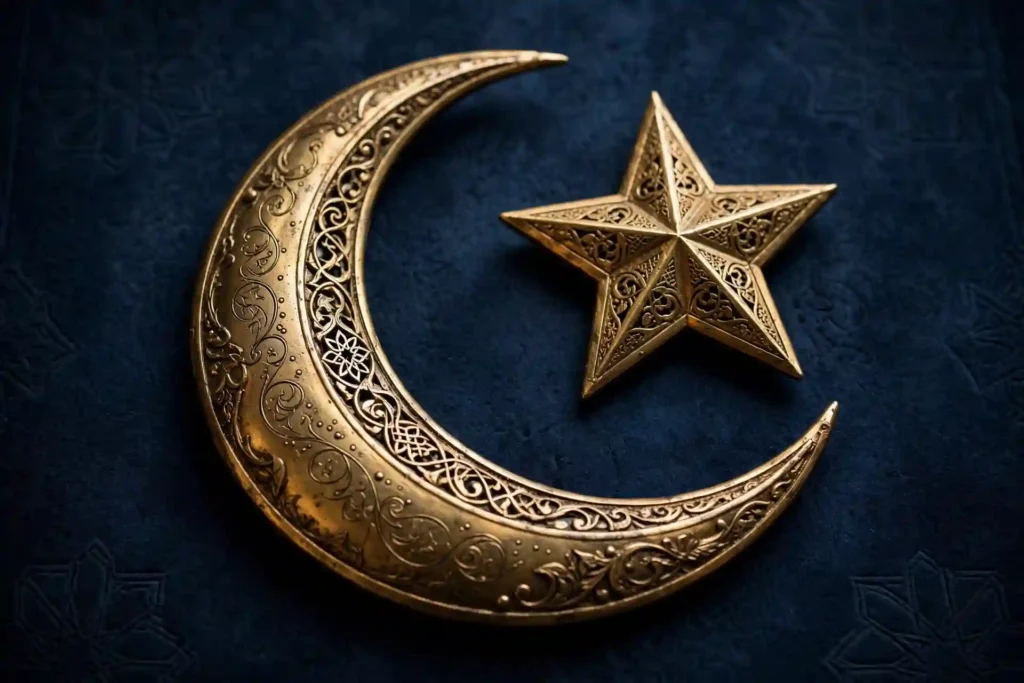
The symbol usually shows a thin crescent moon with a five-pointed star placed near it. The star may appear inside the curve of the crescent or just outside it.
People often call it the Islamic crescent, star and crescent, or crescent and star.
Its appearance can change from one place to another. Some designs have a small star, while others use a large star. Some use several stars. The crescent may face left, right, upward, or in another direction.
Because the design is simple, it is easy to recognize. It has also been used in many forms of art, including flags, jewelry, architecture, clothing, coins, and decorative objects.
The important point is that the design itself does not have one single meaning for every person. A Muslim may see it as a sign of cultural identity, while another person may see it as a symbol of the moon, night, or spiritual reflection.
Is the Crescent Moon and Star an Islamic Symbol?
The crescent moon and star is widely associated with Islam today, but it is not a required Islamic symbol.
Islam does place importance on the moon because the Islamic calendar is based on lunar months. Important religious occasions, including Ramadan and Eid, are connected with the lunar calendar and the sighting of the new moon.
This helps explain why the crescent has become meaningful in many Muslim communities. Still, the crescent and star itself was not created as a symbol of Islam by the Prophet Muhammad.
The symbol also existed in cultures and societies outside Islam. Over time, it became strongly linked with Muslim lands and governments.
This distinction matters because saying that the crescent and star is an ancient official symbol of Islam can make the history sound simpler than it really is.
Crescent Moon and Star Meaning in Islam
For many people, the crescent moon has a natural connection to the Islamic calendar.
The beginning of a new Islamic month is traditionally connected with the appearance or sighting of the new moon. This makes the moon a meaningful part of Muslim religious life.
The star can add another layer of meaning. Stars are often connected with light, direction, and guidance. In a general spiritual sense, a star shining in the darkness can remind people of hope and a path forward.
However, these symbolic meanings should not be treated as one fixed religious rule. Muslims around the world may understand the crescent and star differently.
| Islamic connection | Why it matters |
| Lunar calendar | Muslim months follow the moon |
| Ramadan | Its beginning and end are linked to lunar observation |
| Eid | Religious dates follow the Islamic lunar calendar |
| Crescent moon | Often reminds people of the new lunar month |
| Star | Can suggest light, direction, or hope in symbolic art |
| Muslim identity | Commonly used in cultural and national settings |
The History of the Crescent and Star
The history of the crescent and star is older than its modern connection with Islam.
Crescent shapes appeared in different ancient cultures. The moon itself was also important in many early societies because people used it to understand time and seasons.
The crescent was later used in parts of the Islamic world in different artistic and political settings. It did not have one universal meaning at first.
One important part of the story is the Ottoman Empire. The crescent became strongly associated with Ottoman power and identity, and the star-and-crescent design became increasingly recognizable in later centuries.
The symbol then appeared in different forms on flags, buildings, military objects, clothing, and decorative art. As Muslim-majority countries developed modern national identities, some adopted designs featuring the crescent and star.
This helped turn the symbol into one of the best-known visual signs associated with Muslim cultures.
The history is therefore better understood as a gradual development rather than a single moment when the symbol was created.
Why Is the Crescent Moon Important in Muslim Culture?
The moon has a practical role in Islamic life because the Islamic calendar is lunar.
A lunar calendar follows the phases of the moon rather than the solar year. This is why important Muslim months and celebrations move through the seasons over time.
The crescent can therefore remind people of time, new beginnings, and the changing phases of life.
For example, Ramadan begins and ends according to the Islamic lunar calendar. The sighting of the new moon has traditionally played an important role in determining religious dates.
The moon can also have a beautiful emotional meaning. A thin crescent in the night sky may remind someone of peace, patience, prayer, or a fresh beginning.
These ideas are often personal rather than official religious definitions.
What Does the Star Represent?
The star in the crescent-and-star design can have several possible meanings.
One common interpretation is guidance. A star shines in the darkness, so it can naturally represent light, direction, or hope.
Stars also have a long connection with navigation. Before modern technology, people looked at the night sky to help understand direction and travel.
In religious and cultural art, stars may therefore suggest knowledge, guidance, beauty, or the vastness of creation.
It is also important not to assume that every star in a crescent-and-star design has a secret religious meaning. Sometimes a star is simply part of the traditional design.
Spiritual Meaning of the Crescent Moon and Star
Beyond history and religion, many people give the crescent and star a personal spiritual meaning.
The crescent moon can represent change. The moon does not always look the same. It grows, becomes full, and then becomes smaller again. Because of this cycle, people may see it as a reminder that life also moves through different stages.
The star can represent hope. Even a small light can be easy to see in a dark sky.
Together, the two symbols can suggest a simple message: even during dark or changing times, there can still be light and hope.
Some people may also connect the image with inner peace, faith, wisdom, protection, or a new beginning.
These meanings are personal interpretations, not universal religious definitions.
Crescent Moon and Star Meaning in Different Cultures
The symbol is strongly associated with Muslim cultures today, but it should not be treated as belonging to only one culture.
The crescent and star has appeared in different artistic and cultural traditions. Similar moon-and-star designs can also have meanings that are separate from Islam.
For example, African artistic traditions may use moon and star imagery with meanings tied to local beliefs and cultural ideas. In modern countries, the same basic design may represent national identity rather than religion alone.
This is why context matters.
A crescent and star on a mosque may suggest Muslim identity. The same image on a piece of jewelry may represent cultural heritage, personal faith, or simply an interest in celestial symbols.
Crescent Moon and Star on Flags
The crescent and star can be seen on the flags of several countries with Muslim-majority populations.
One of the most famous examples is the flag of Turkey, which features a white crescent and star on a red background. Other national flags also use related designs, sometimes with different colors, positions, or numbers of stars.
The meaning of a national flag is not always identical to the meaning of the symbol in religion.
A flag represents a country and its people. Therefore, a crescent and star on a national flag can carry ideas about history, independence, culture, and national identity as well as connections to Islam.
| Use of crescent and star | Possible meaning |
| National flag | National identity and history |
| Mosque decoration | Muslim cultural or religious association |
| Jewelry | Faith, heritage, beauty, or personal identity |
| Clothing | Cultural pride or fashion |
| Artwork | Night, spirituality, history, or beauty |
| Tattoo | Personal symbolism or identity |
Crescent Moon and Star Meaning in Dreams
Some people search for the crescent and star meaning because they saw the image in a dream.
Dream symbolism is personal, so there is no single proven meaning. A crescent moon might remind one person of change, while another person may connect it with faith or a loved one.
A star may suggest hope, direction, or a goal. Seeing both together could feel like a reminder to keep moving forward during a period of change.
If you are thinking about a dream, consider what the symbol meant to you rather than relying only on a dream dictionary. Your feelings, memories, beliefs, and current situation can influence how you understand the image.
Common Misunderstandings About the Crescent and Star
One common mistake is saying that the crescent and star was always the official symbol of Islam. That is not accurate.
Another mistake is assuming that every Muslim person views the symbol in exactly the same way. Muslims live in many countries and cultures, so their views can differ.
It is also incorrect to assume that the symbol has only one historical origin. Moon and crescent imagery existed in different cultures before and outside the modern Muslim world.
Finally, the star does not always have one fixed meaning. Depending on the context, it can represent guidance, light, national identity, decoration, or something else entirely.
Understanding these differences makes the symbol more interesting, not less meaningful.
Crescent Moon and Star in Modern Life
Today, the crescent and star can be found in many places.
You may see it on national flags, Islamic art, jewelry, greeting cards, wedding decorations, Ramadan designs, clothing, logos, and social media graphics.
During Ramadan and Eid, crescent moons and stars are especially common in decorative designs. They can create a visual connection with the night sky and the lunar calendar.
Modern designers also use the symbol simply because it is attractive and easy to recognize.
Its meaning can therefore range from deeply religious to strongly cultural or purely decorative.
Frequently Asked Questions
Is the crescent and star the official symbol of Islam?
No. Islam does not have an official crescent-and-star emblem established by the Qur’an. The design became associated with Muslim societies through history and later became common in national and cultural symbols.
What does the crescent moon mean in Islam?
The crescent is often connected with the Islamic lunar calendar and the beginning of lunar months. It can also remind people of Ramadan, Eid, renewal, and new beginnings.
What does the star mean next to the crescent moon?
The star can symbolize light, guidance, hope, or direction. Its exact meaning depends on the culture and context in which it appears.
Is the crescent and star older than Islam?
Crescent and celestial symbols existed in cultures before Islam. The specific star-and-crescent design has a complex history and became strongly connected with Muslim societies over time.
Why do Muslim countries use the crescent and star?
Some Muslim-majority countries use crescent and star designs because of historical, cultural, political, or national traditions. The meaning differs from country to country.
What does a crescent moon and star mean spiritually?
A common personal interpretation is that the crescent represents change or renewal, while the star represents hope and guidance. This is a symbolic interpretation rather than a universal religious teaching.
Conclusion
The crescent moon and star meaning is rich because the symbol has both historical and modern significance.
Today, it is widely connected with Islam and Muslim identity, but its history is more complex than simply calling it the official symbol of Islam.
The crescent has an important connection with the Islamic lunar calendar, while the star can suggest light, hope, and guidance.
The symbol has also become part of national flags, art, jewelry, clothing, and modern design. Its meaning can change depending on the person and setting.
When you see a crescent and star, the best approach is to consider its context. It may represent faith, culture, history, national identity, personal hope, or simply the beauty of the night sky.

Muhammad Haroon is the founder and writer behind Factnora.com, a platform focused on sharing interesting, useful, and reliable information. His work covers biographies, history, facts, and stories that help readers discover something new in a simple and engaging way. Through factnora, Muhammad aims to make learning enjoyable while presenting information in a clear and reader-friendly style.