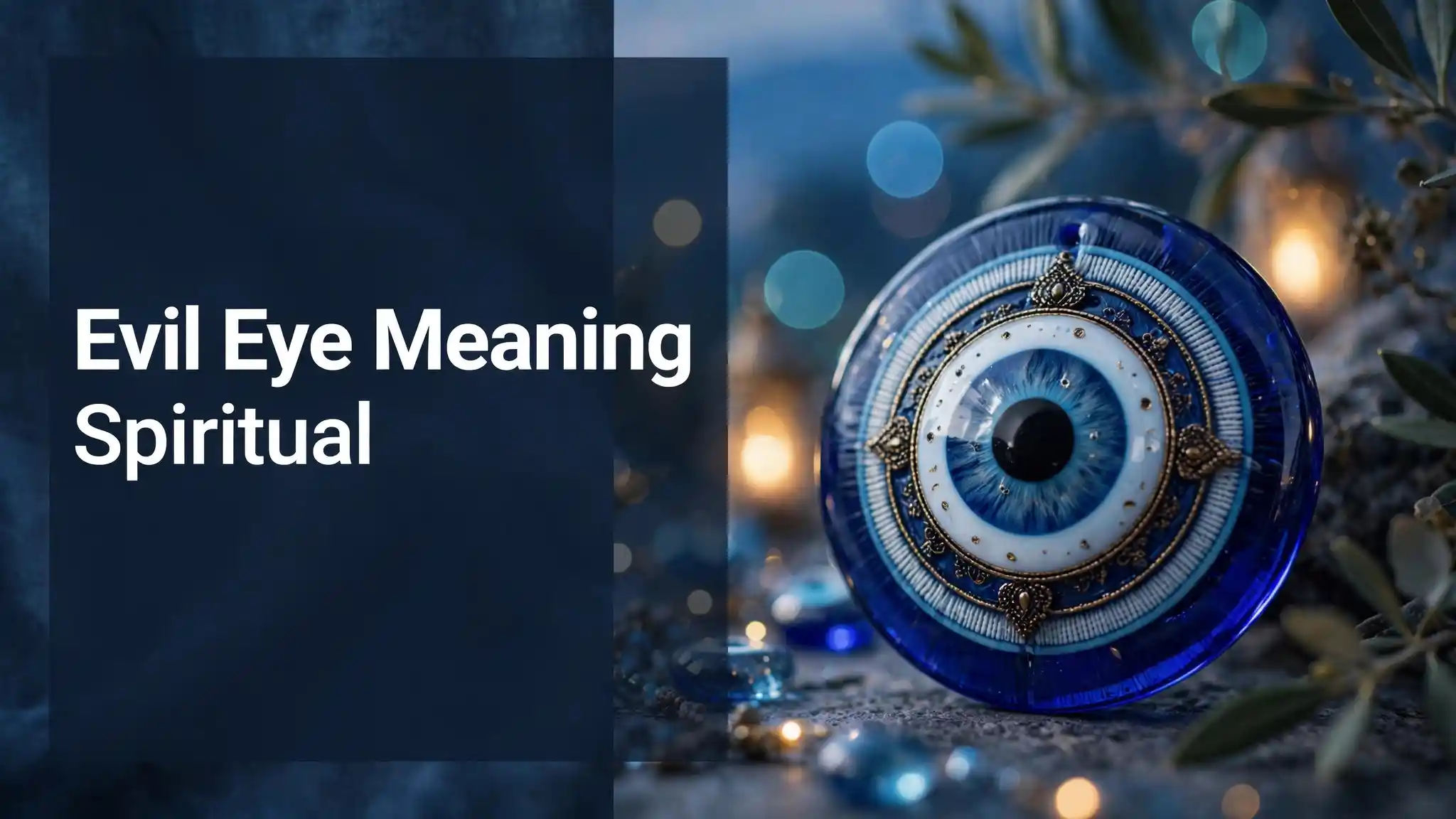
The evil eye meaning spiritual often refers to the belief that a person can be harmed by another person’s envy, jealousy, or harmful attention.
Across many cultures, the evil eye is seen as a form of spiritual protection and a warning to be careful about negative energy. Some people use symbols, prayers, blessings, or protective customs to guard against it.
Others view it mainly as a cultural tradition rather than a proven spiritual force. In this guide, we’ll explore what the evil eye means spiritually, where the belief comes from, what the symbol represents, and how different traditions understand it.
We’ll also look at common signs people connect with the evil eye and explain how to approach these beliefs in a thoughtful and respectful way.
Quick Answer: What Is the Evil Eye Meaning Spiritual?
The evil eye meaning spiritual is the belief that harmful feelings such as envy or jealousy can bring misfortune, weakness, or negative influence to another person. In many traditions, the evil eye is not simply a physical eye or symbol. It represents the idea of harmful attention directed toward someone.
People may believe that the evil eye can affect areas such as health, relationships, success, peace, or good fortune. Because of this, protective symbols, prayers, religious practices, and traditional customs developed in many parts of the world.
It is important to separate cultural or spiritual belief from scientific fact. There is no scientific proof that another person’s gaze can create supernatural harm. Still, the evil eye has deep historical and cultural meaning for many communities.
What Does the Evil Eye Mean Spiritually?

Spiritually, the evil eye is often connected with envy, jealousy, unwanted attention, and protection.
Imagine someone receives a new job, buys a home, gets married, or achieves an important goal. In some traditional beliefs, another person may feel strong envy toward that success. The concern is not always that the person openly wishes harm. Instead, the belief suggests that intense envy or attention may carry negative spiritual energy.
This is why the evil eye can have two related meanings. It can describe the harmful influence itself, but it can also describe a protective symbol used against that influence.
| Spiritual idea | Common meaning |
| Evil eye | Harm connected with envy or harmful attention |
| Envy | Wanting what another person has |
| Jealousy | Fear of losing something or wanting another person’s advantage |
| Protection | Practices meant to guard against perceived harm |
| Evil eye symbol | A traditional sign associated with protection |
For many people, the deeper lesson is about staying humble, avoiding harmful jealousy, and protecting personal peace.
The Spiritual Meaning Behind Evil Eye Symbols
The familiar evil eye symbol often looks like a blue or blue-and-white eye. It is commonly called a nazar in Turkish and related cultural settings.
The symbol is especially associated with protection in parts of the Mediterranean, Middle East, North Africa, and surrounding regions. Similar beliefs and protective customs have appeared in many different cultures, although their meanings are not always identical.
The eye itself can represent watchfulness and protection. A protective eye symbol may be placed in a home, worn as jewelry, or displayed on an object.
However, it is important not to assume that everyone who wears an evil eye bracelet or necklace follows the same spiritual belief. Some people wear it because of family tradition, cultural identity, fashion, or personal meaning.
| Evil eye symbol or practice | Possible meaning |
| Blue eye charm | Protection from harmful attention |
| Evil eye bracelet | Personal or cultural protection |
| Necklace with an eye | A reminder of protection or tradition |
| Eye displayed in a home | Protection and watchfulness |
| Prayer or blessing | Spiritual protection within a religious tradition |
The symbol does not have one universal meaning. Its meaning depends on the culture, religion, and personal beliefs of the person using it.
Where Did the Evil Eye Belief Come From?
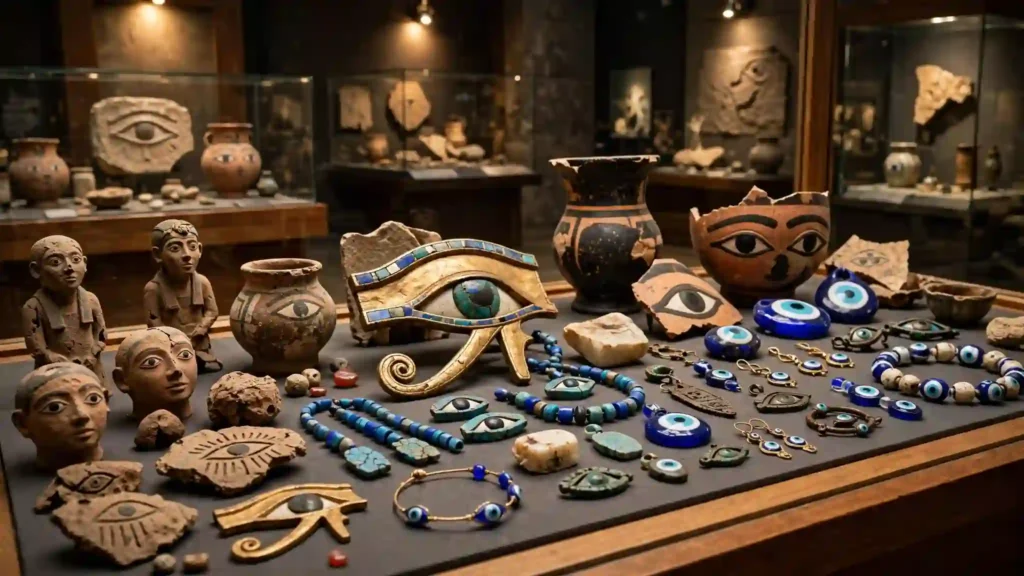
The evil eye is an ancient belief with a long and complex history. It did not begin with one single modern religion or one single culture.
Ideas about harmful looks or envy appear in ancient societies around the Mediterranean and Near East. Historical evidence shows that people in different civilizations developed beliefs and protective practices connected with the evil eye.
Ancient writers also discussed the idea of a harmful gaze. Over time, similar concepts became part of different religious and cultural traditions.
Because the belief is so old, it is not accurate to say that the evil eye belongs exclusively to one country, religion, or group. Its forms and meanings have changed across time.
In some traditions, protection involves prayer. In others, it may involve an amulet, gesture, blessing, or household object.
The common thread is the fear that envy or harmful attention can affect another person, along with the desire to protect oneself and one’s family.
Evil Eye Meaning in Different Spiritual Traditions
The evil eye is understood differently around the world. Some traditions treat it as a serious spiritual concern, while others see it mainly as folklore or cultural heritage.
In Islamic traditions, the concept of the evil eye, known as al-ayn, is recognized in Islamic teachings. Muslims may seek protection through prayer and Quranic recitation. Islamic teachings also emphasize remembering God and avoiding envy.
In Jewish traditions, beliefs about the evil eye, often called ayin hara, have appeared in Jewish thought and folklore. Practices and interpretations vary among communities.
In parts of Christian culture, beliefs about the evil eye have also existed as folk traditions. However, the belief is not a central teaching of Christianity as a whole.
In Mediterranean and Middle Eastern cultures, protective charms and customs connected with the evil eye have a long history.
This variety matters because there is no single spiritual definition that explains every person’s belief.
What Are the Common Spiritual Signs of the Evil Eye?

People who believe in the evil eye sometimes connect it with sudden or unexplained problems. These may include bad luck, stress, tiredness, arguments, or a series of unwanted events.
Some traditions may describe symptoms such as headaches, weakness, trouble sleeping, or a sudden change in mood. But these experiences can have many ordinary causes.
For example, a person may have a headache because they are dehydrated, tired, stressed, or ill. It would not be safe to assume that the evil eye caused the problem.
Here is a useful distinction:
| Experience | Possible everyday explanation | Spiritual interpretation in some traditions |
| Feeling tired | Poor sleep or stress | Loss of spiritual energy |
| Headache | Dehydration or illness | Possible spiritual harm |
| Anxiety | Life stress | Negative influence |
| Sudden conflict | Miscommunication | Harmful energy or envy |
| Bad luck | Chance or circumstances | Evil eye or spiritual interference |
These spiritual interpretations are matters of belief, not medical or scientific diagnoses.
If you have ongoing physical or emotional symptoms, it is wise to seek appropriate professional help rather than relying only on spiritual explanations.
Why Is Envy So Important to the Evil Eye?
Envy is one of the strongest ideas connected with the evil eye.
Envy happens when someone wants what another person has. It might be money, beauty, success, a relationship, health, popularity, or a new opportunity.
Many cultures warn against envy because it can damage relationships even without any supernatural element. A person who constantly compares themselves with others may become unhappy. Someone who is the target of envy may also feel uncomfortable or mistrustful.
This gives the evil eye belief a practical lesson: celebrate your blessings without using them to make others feel small.
It also encourages people to avoid becoming consumed by comparison.
In that sense, the spiritual meaning can be understood as a reminder to practice humility, gratitude, kindness, and self-awareness.
What Does It Mean When Someone Gives You the Evil Eye?
In everyday language, “giving someone the evil eye” can mean looking at them with anger, dislike, suspicion, or jealousy.
For example, if someone receives praise and another person gives them a cold, unfriendly stare, a friend might jokingly say, “She gave you the evil eye.”
The phrase does not always mean that the speaker believes in supernatural harm. In modern English, it can simply describe an unfriendly look.
| Expression | Meaning |
| Give someone the evil eye | Look at someone with hostility or disapproval |
| Ward off the evil eye | Try to protect against perceived harm |
| Evil eye charm | A traditional protective object |
| Evil eye belief | The idea that harmful attention can cause misfortune |
This is why context matters when interpreting the phrase.
Is the Evil Eye a Religious Belief or a Cultural Tradition?
It can be either, depending on the person and community.
For some people, the evil eye is closely connected to religious teachings and spiritual practices. For others, it is a family tradition passed down through generations.
Someone may wear an evil eye bracelet because their grandmother gave it to them. Another person may use a protective prayer because of their faith. Someone else may keep an evil eye decoration simply because it reminds them of their culture.
There is no need to assume that every person using the symbol believes exactly the same thing.
A respectful approach is to ask what the symbol means to the individual.
How Do People Protect Themselves From the Evil Eye?
Protective practices differ widely.
Some people use prayer, scripture, blessings, meditation, or other spiritual practices. Others wear traditional charms or keep protective objects in their homes.
In some cultures, people may avoid showing off their success because they believe too much attention can attract envy. This can also have a practical side: keeping some personal matters private can protect your peace and reduce unwanted attention.
If you follow a particular religion, the safest approach is to use protection practices that fit your own faith rather than mixing unrelated traditions without understanding them.
Spiritual practices can offer comfort and meaning, but they should not replace medical care, financial advice, or other professional help when those things are needed.
Common Mistakes About the Spiritual Meaning of the Evil Eye
One common mistake is assuming that every problem is caused by the evil eye. A difficult week, illness, relationship problem, or financial setback does not prove supernatural harm.
Another mistake is believing that every person who looks at you with envy is trying to hurt you. People can experience jealousy without intending harm.
It is also easy to confuse the evil eye with a single universal religious teaching. In reality, beliefs differ greatly across cultures and religions.
A final mistake is treating a protective charm as a guaranteed solution to every problem. A symbol can have deep cultural or personal meaning, but it should not be presented as scientifically proven protection.
A balanced view respects spiritual beliefs while also considering ordinary explanations.
Real-Life Examples of Evil Eye Beliefs
Imagine a family celebrates the birth of a baby. A relative may say a blessing and use a traditional practice believed to protect the child from the evil eye.
Another example is a person who gets a major promotion. Their family may remind them to stay humble and not boast about their success. This can be both a cultural practice and a way to avoid attracting unwanted attention.
A third example involves jewelry. Someone may wear a small evil eye necklace because it reminds them to feel protected and grounded.
These examples show how the evil eye can have both spiritual and social meaning.
FAQs
What is the evil eye meaning spiritually?
Spiritually, the evil eye usually refers to the belief that envy, jealousy, or harmful attention can bring negative effects to another person. Different cultures understand it in different ways.
Is the evil eye real?
The evil eye is real as a cultural and spiritual belief held by many people. However, there is no scientific evidence that a person’s gaze can cause supernatural harm.
What does an evil eye symbol mean?
An evil eye symbol is commonly connected with protection from envy or harmful attention. Its exact meaning varies by culture, religion, and personal belief.
What does it mean when someone gives you the evil eye?
In everyday English, giving someone the evil eye usually means looking at them with anger, dislike, jealousy, or strong disapproval. It does not always imply a supernatural belief.
Is wearing an evil eye bracelet religious?
Not necessarily. Some people wear an evil eye bracelet for religious or spiritual reasons, while others wear it because of cultural tradition, family history, or fashion.
How can I protect myself from the evil eye?
People use different practices depending on their beliefs. These may include prayer, religious recitation, blessings, traditional customs, or protective symbols. Choose practices that fit your own values and faith.
Conclusion
The evil eye meaning spiritual is mainly connected with envy, harmful attention, protection, and the desire to guard one’s peace.
The belief is ancient and appears in many cultures, but its meaning is not exactly the same everywhere. Some people understand the evil eye through religion, while others see it as folklore, family tradition, or a cultural symbol.
The most useful way to approach the subject is with respect and balance. You can value a spiritual or cultural tradition without assuming that every problem has a supernatural cause.
If an evil eye symbol gives you comfort or reminds you to stay humble, grateful, and protected, it may hold personal meaning for you.
At the same time, ordinary health, emotional, and practical concerns should be handled in practical ways. Understanding both sides helps you appreciate the rich history behind this powerful symbol.

Muhammad Haroon is the founder and writer behind Factnora.com, a platform focused on sharing interesting, useful, and reliable information. His work covers biographies, history, facts, and stories that help readers discover something new in a simple and engaging way. Through factnora, Muhammad aims to make learning enjoyable while presenting information in a clear and reader-friendly style.