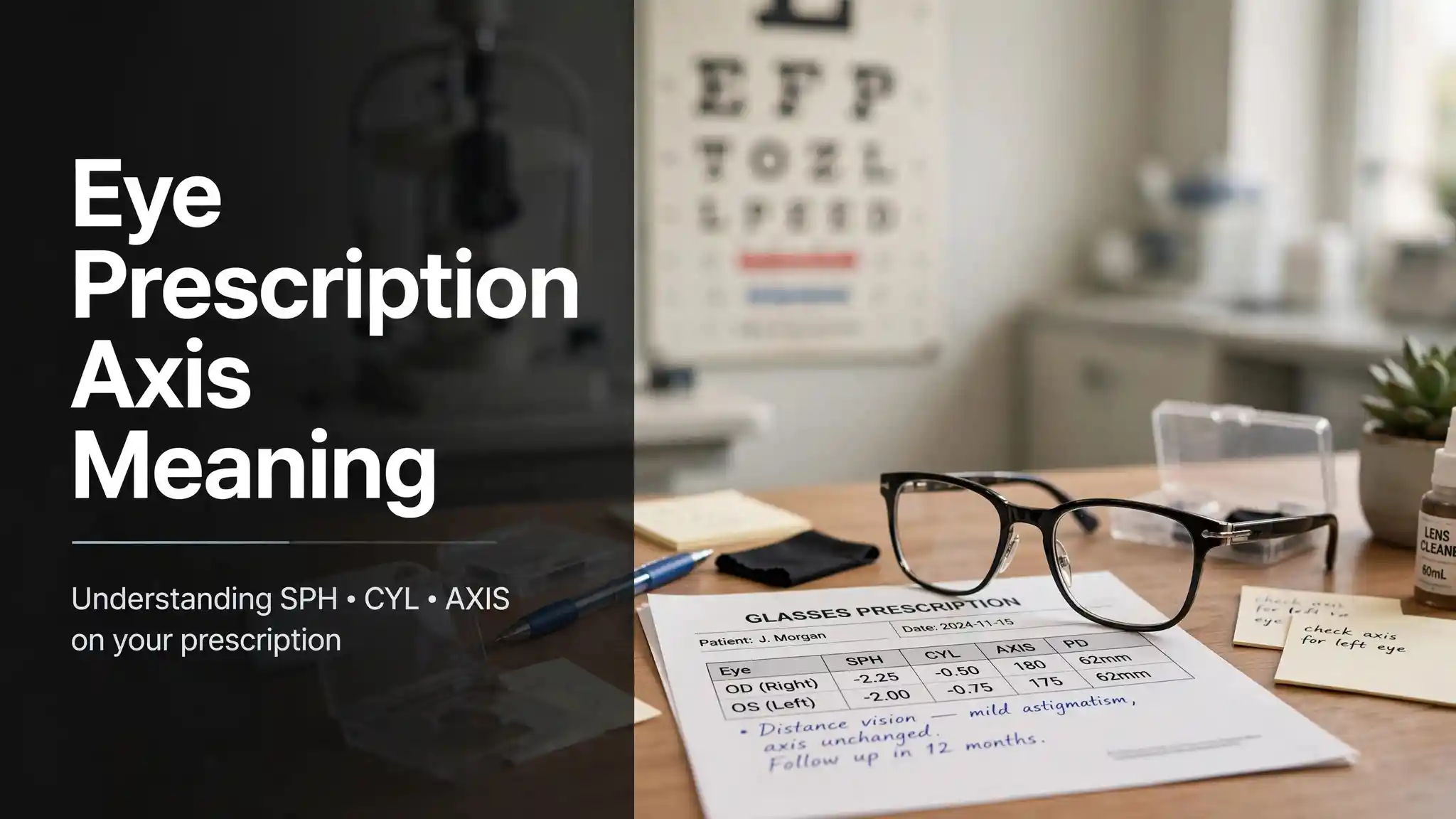
If you see an axis number on an eye prescription, it tells you the direction of astigmatism correction in your lens.
The axis is measured in degrees from 1 to 180. By itself, the axis does not tell you how strong your prescription is; it works together with the cylinder (CYL) number.
Quick Answer: What Does Eye Prescription Axis Mean?
The eye prescription axis meaning is the angle used to show the direction of astigmatism correction. It is measured in degrees, from 1 to 180, and is usually listed next to the CYL (cylinder) value on a glasses prescription.
For example, a prescription might say:
| Prescription part | Example | What it means |
| SPH | -2.00 | Corrects nearsightedness |
| CYL | -1.00 | Corrects astigmatism |
| AXIS | 90 | Shows the direction of the astigmatism correction |
An axis of 90 does not mean your vision is “90% bad” or that you have a stronger prescription. It only describes the orientation of the cylinder correction.
If your prescription has an axis number, it usually means you have some amount of astigmatism that needs correction. The CYL tells you the amount of correction, while the AXIS tells you its direction.
What Is the Axis on an Eye Prescription?
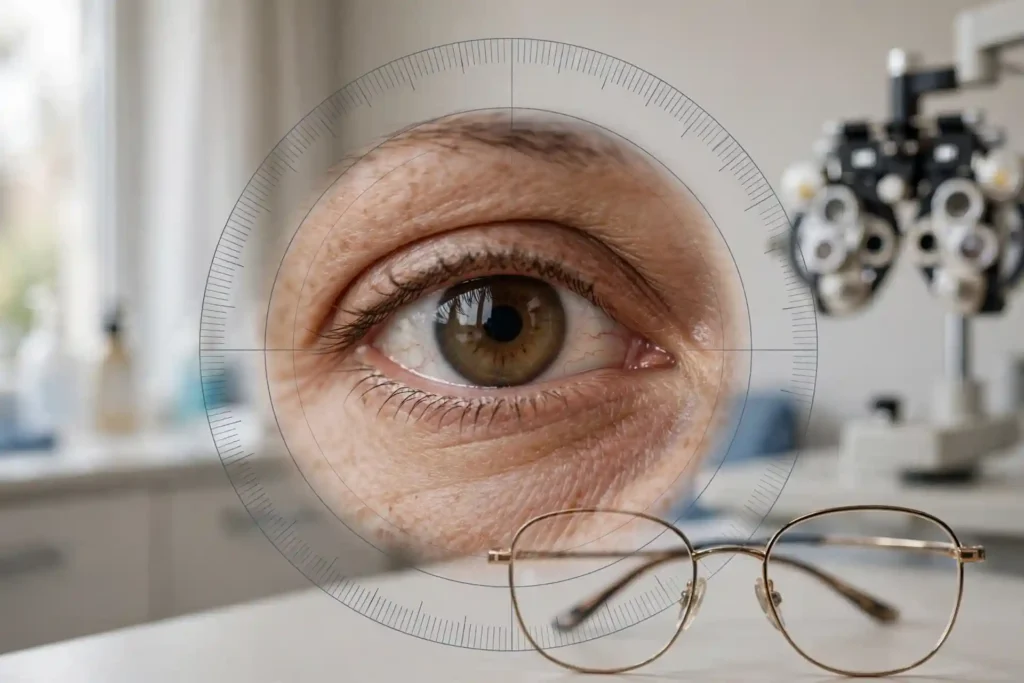
The axis is a measurement used to describe the position of astigmatism in your eye. It is written as a number between 1 and 180 degrees.
Astigmatism happens when the front of the eye, usually the cornea, has a shape that is not perfectly round. Instead of being shaped like a basketball, it may be shaped more like a football. This can cause light to focus unevenly and may make vision look blurry or distorted.
A prescription lens can correct this uneven focus. The axis tells the lens maker which direction the cylinder correction should be placed.
Think of the axis like the angle on a clock. It gives the lens a specific direction to follow. However, an eye prescription uses degrees rather than clock numbers.
For example, an axis of 180 is horizontal, while an axis of 90 is vertical. Other numbers describe angles between those positions.
The important point is that the axis is not a measurement of how severe your astigmatism is. The CYL value gives the amount of astigmatism correction needed.
How the Axis and Cylinder Work Together
The easiest way to understand the axis is to look at it together with the cylinder value.
The CYL and AXIS are closely connected. You generally need both numbers when a prescription includes astigmatism correction.
Here is a simple example:
| Prescription | What it tells you |
| CYL -0.50, AXIS 180 | A small amount of astigmatism correction at 180° |
| CYL -1.00, AXIS 90 | More cylinder correction at 90° |
| CYL -2.00, AXIS 45 | Stronger cylinder correction at 45° |
| CYL 0.00, no axis | No cylinder correction is needed |
Notice that the axis number does not tell you If your vision is better or worse.
For example, -1.00 CYL at 90° and -1.00 CYL at 180° have the same cylinder strength but different directions.
This is why you should not compare axis numbers alone. An axis of 180 is not automatically “better” or “worse” than an axis of 90.
What Do Axis Numbers From 1 to 180 Mean?
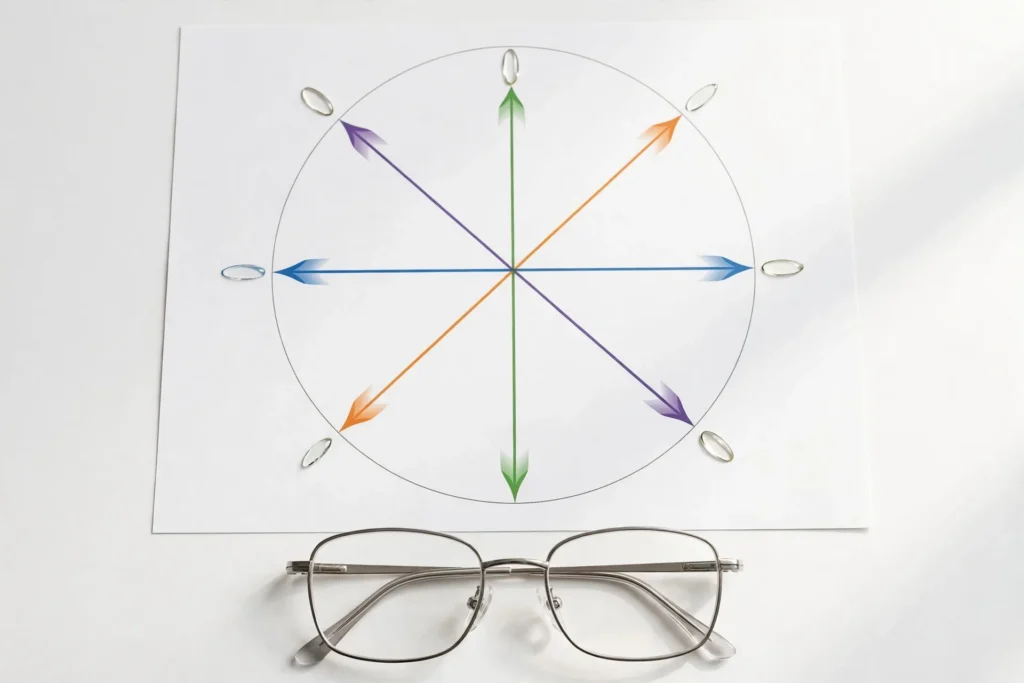
The axis is measured around a circle. It can be written from 1 through 180 degrees.
Some common axis values include:
| Axis | Simple description |
| 1° | Almost horizontal |
| 45° | Diagonal direction |
| 90° | Vertical direction |
| 135° | Opposite diagonal direction |
| 180° | Horizontal direction |
The numbers between these points represent other angles.
For instance, an axis of 45° means the cylinder correction is placed at a diagonal angle. An axis of 135° represents another diagonal direction.
You may notice that prescriptions do not normally use an axis of 0°. Instead, the scale runs from 1 to 180, with 180 representing the horizontal position.
The number itself is simply a direction. It does not describe the quality of your eyesight.
Why Does My Prescription Have an Axis Number?
Your prescription has an axis number because your eye doctor found astigmatism that needs correction.
Astigmatism can cause several vision problems. You might notice blurry vision at near or far distances, trouble seeing fine details, eye strain, or headaches, although symptoms can vary.
When an eye care professional measures your vision, they determine how much cylinder power is needed and where that correction should be positioned.
The result may look something like:
SPH -1.50 / CYL -0.75 / AXIS 180
This means:
- SPH -1.50: correction for nearsightedness
- CYL -0.75: correction for astigmatism
- AXIS 180: direction of that astigmatism correction
All three numbers work together to create the lens prescription.
Does a Higher Axis Number Mean Worse Eyesight?
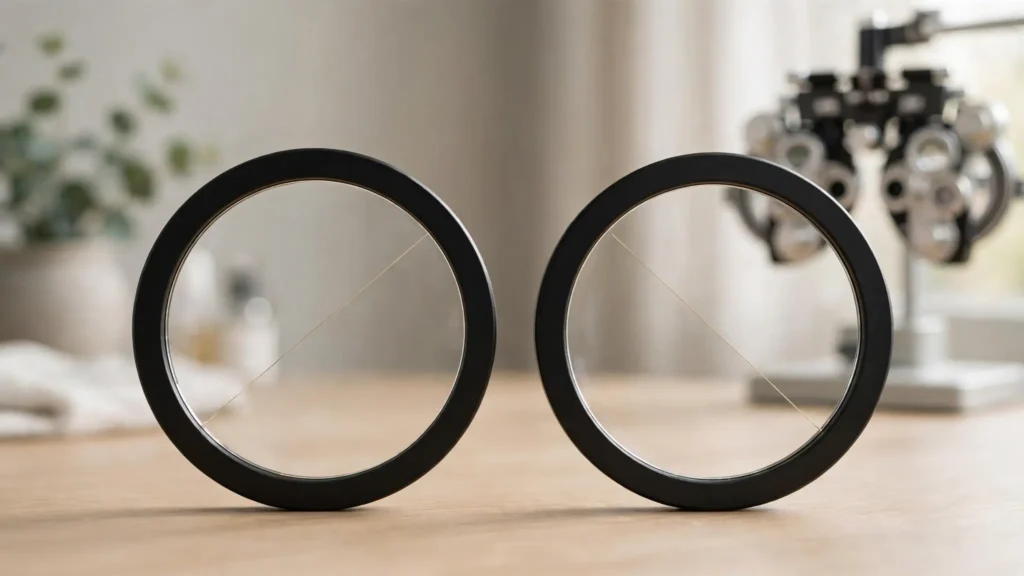
No. A higher axis number does not mean you have worse eyesight.
This is one of the most common misunderstandings about eye prescriptions.
For example, someone might have:
-0.75 CYL at 20°
Another person might have:
-0.75 CYL at 160°
The axis values are very different, but the cylinder strength is the same.
The amount of astigmatism correction is related to the CYL number, not simply If the axis number is high or low.
So, an axis of 170 is not stronger than an axis of 30. They are simply different directions.
What Does an Axis of 90 Mean?
An axis of 90 means the cylinder correction is oriented at 90 degrees.
In simple terms, 90 degrees represents a vertical direction.
You may see 90 on a prescription because the astigmatism correction needed by that eye has that particular orientation.
But remember: 90 does not mean your eye is 90% damaged or that your vision is 90% poor.
The number only describes the angle.
The CYL number next to it is what tells you how much astigmatism correction is needed.
What Does an Axis of 180 Mean?
An axis of 180 represents a horizontal direction.
It is one of the most commonly seen axis values on eyeglass prescriptions. Like every other axis number, it does not show how strong your prescription is.
For example:
CYL -1.25 AXIS 180
means the prescription includes 1.25 diopters of cylinder correction, oriented at 180 degrees.
If another prescription says:
CYL -1.25 AXIS 90
the amount of cylinder correction is the same, but its orientation is different.
That difference matters when the lenses are made because the correction must be placed correctly.
What Does It Mean If the Axis Is Missing?
If your prescription does not have an axis number, you may not need cylinder correction for astigmatism.
For example, a simple prescription might look like:
OD: -2.00 SPH
OS: -1.50 SPH
Here, only the spherical power is listed.
However, prescriptions can be written in different formats, and some may contain other measurements. If you are unsure about a prescription, ask your eye doctor or optician rather than trying to guess.
The exact prescription matters when ordering glasses or contact lenses.
OD and OS: Which Eye Is Which?
Eye prescriptions often use the abbreviations OD and OS.
These terms can look confusing at first, but they are easy to understand.
| Abbreviation | Meaning | Eye |
| OD | Oculus dexter | Right eye |
| OS | Oculus sinister | Left eye |
| OU | Oculus uterque | Both eyes |
So, if your prescription says:
OD: -1.00 -0.75 × 90
the axis of 90 applies to your right eye.
If it says:
OS: -1.50 -1.00 × 180
the axis of 180 applies to your left eye.
The numbers can be different for each eye because each eye may need a different type or amount of correction.
How to Read a Full Eye Prescription
An eyeglass prescription can look complicated, but each part has a job.
A typical prescription may include:
OD: -2.00 -1.00 × 90
OS: -1.50 -0.50 × 180
Here is what the numbers mean:
| Part | Purpose |
| OD | Right eye |
| OS | Left eye |
| SPH | Main spherical lens power |
| CYL | Amount of astigmatism correction |
| AXIS | Direction of cylinder correction |
The sphere (SPH) value can be positive or negative. A negative number is commonly used for nearsightedness, while a positive number is commonly used for farsightedness.
The cylinder (CYL) value measures the amount of astigmatism correction.
The axis tells where that cylinder correction is positioned.
Together, these measurements help create the correct lens.
Can the Axis Change Over Time?
Yes, your prescription can change over time, including the axis.
Eyes can change as you age, and the amount or direction of astigmatism may also change. However, there is no single rule that says everyone’s axis will change in the same way.
Sometimes the change may be small. Other times, your eye doctor may find a more noticeable difference between prescriptions.
This is why it is important to use your current prescription when getting new glasses.
Do not assume that an old prescription is still correct just because your glasses look fine.
Regular eye exams can help identify changes in your vision and eye health.
Can You Order Glasses Without Knowing the Axis?
If your prescription includes a CYL value, you generally need the corresponding axis to order prescription glasses correctly.
For example, knowing only:
CYL -1.00
is not enough if the prescription also requires an axis.
You should use the complete prescription provided by your eye care professional.
If you lost your prescription, contact the eye doctor’s office or optical provider that has your records. They can tell you what information you need.
Do not try to estimate the axis based on an old pair of glasses or by looking at the lenses yourself.
Common Mistakes About Eye Prescription Axis
Many people misunderstand the axis because the number looks like a measurement of vision strength.
One common mistake is thinking that 180 is worse than 90. It is not. Both numbers simply represent different directions.
Another mistake is thinking that the axis tells you how much astigmatism you have. It does not. The CYL value tells you the amount of cylinder correction.
Some people also confuse the axis with the sphere number. Sphere power and cylinder axis have different jobs.
Finally, avoid changing your prescription yourself. Even a small change in cylinder or axis can affect how your lenses correct your vision.
When Should You Talk to an Eye Doctor?
If your glasses suddenly seem blurry, uncomfortable, or different from what you remember, it is worth checking your prescription.
You should also seek professional eye care if you have sudden changes in vision, new flashes or floaters, eye pain, double vision, or sudden loss of vision. Some sudden vision changes can require urgent medical attention.
An eye prescription is more than a list of numbers. It is based on measurements of your eyes and your visual needs.
An eye doctor or qualified eye care professional can explain what each number means for you.
FAQs
What does axis mean on an eye prescription?
The axis shows the direction of astigmatism correction in a lens. It is measured in degrees from 1 to 180 and works with the cylinder value.
Is a higher axis number worse?
No. A higher axis number does not mean worse eyesight. The axis only describes the direction of the cylinder correction.
Is an axis of 90 good or bad?
An axis of 90 is neither good nor bad. It simply means the cylinder correction is oriented at 90 degrees.
What does axis 180 mean in glasses?
Axis 180 represents a horizontal orientation for the cylinder correction. It does not indicate the strength of your prescription.
Do you need an axis for astigmatism?
If your prescription includes cylinder correction for astigmatism, it normally also includes an axis. The two values work together.
Can the axis of your eye prescription change?
Yes. Your prescription, including the axis, can change over time. The best way to know your current axis is through an up-to-date eye examination.
Conclusion
Understanding the eye prescription axis meaning can make a confusing glasses prescription much easier to read.
The axis is simply the direction of the cylinder correction used to treat astigmatism. It is measured from 1 to 180 degrees and does not tell you how strong your eyesight is.
The most important thing to remember is that the CYL number tells you the amount of astigmatism correction, while the AXIS tells you its direction. These numbers work together, so both are important when making prescription lenses.
If you are unsure about your prescription, do not guess or change the numbers yourself. Ask your eye doctor or optician to explain them.
Using an accurate, current prescription helps make sure your glasses provide the clearest and most comfortable vision possible.

Ali Sher is a writer and the creator of Factnora.com, a website dedicated to sharing fascinating facts, biographies, history, and useful knowledge. He enjoys researching interesting topics and turning them into simple, engaging stories for readers. Through factnora, Muhammad aims to provide informative content that is easy to understand, enjoyable to read, and worth sharing.