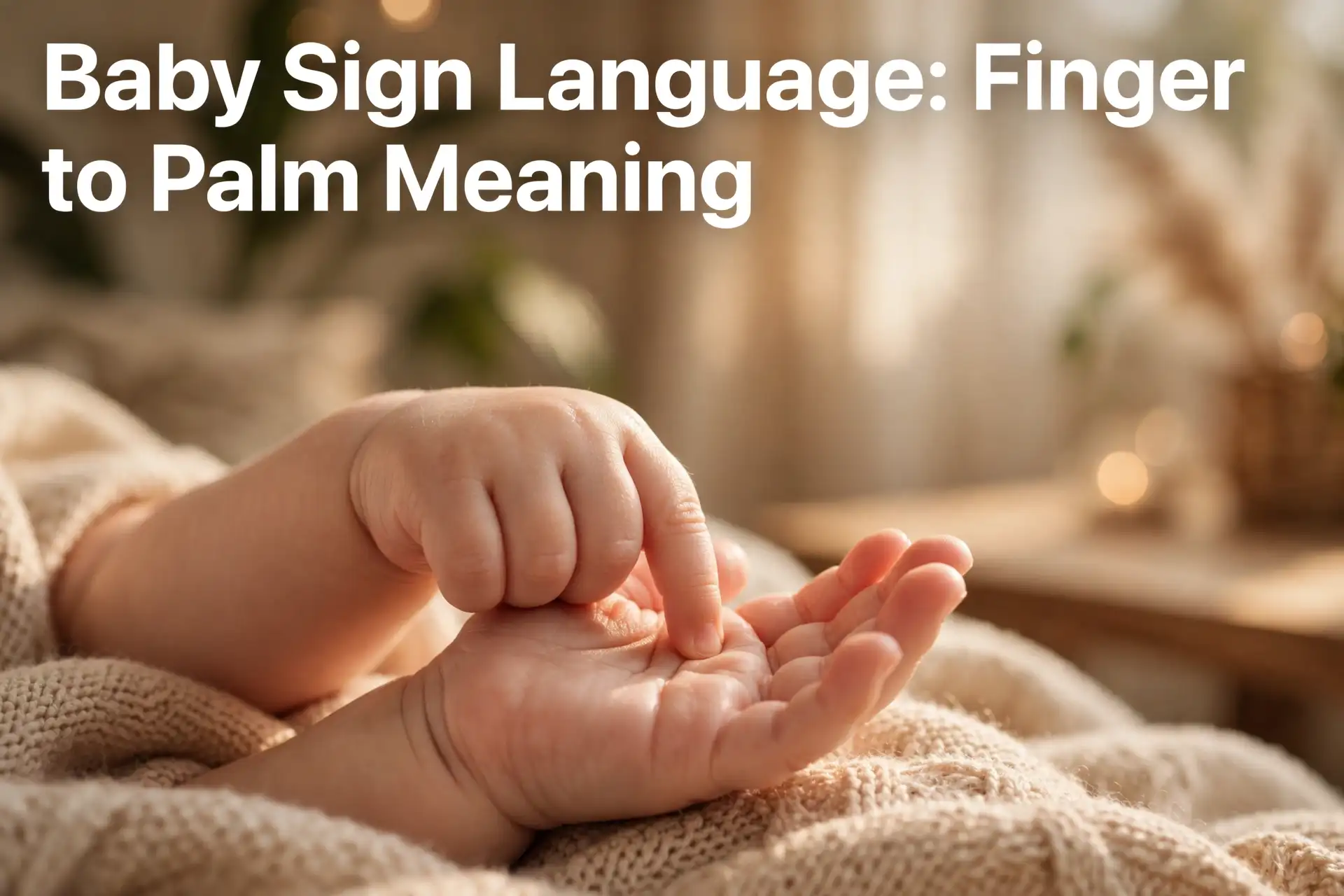
You see your baby touch a finger to their open palm, and you freeze. What was that? Was it a random wiggle, or was your baby actually trying to talk to you? If you have been searching for the baby sign language finger to palm meaning, you are not alone.
Thousands of parents notice this small gesture every day and wonder what it says. The good news is that this tiny movement is one of the most common first signs babies learn.
In this guide, you will learn exactly what the finger to palm gesture means, how to do the sign correctly, when babies start using it, and how to tell what your baby really wants when they do it.
Quick Answer: What Does Finger to Palm Mean in Baby Sign Language?
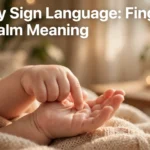
When a baby touches a finger to their open palm, it almost always means “more.” Your baby is asking for more of something. That could be more food, more milk, more playtime, or more fun.
The grown-up version of this sign is tapping the fingertips of both hands together. But little hands are still learning, so babies often simplify it.
Instead of tapping both hands neatly, they press one finger, or a few fingers, right into the palm of the other hand. Same message. The context tells you the rest: at the dinner table, it means more food. On the play mat, it means more play.
Why Babies Sign Before They Can Talk
Babies understand words long before they can say them. A nine-month-old may know exactly what “cookie” means but cannot shape the sounds yet. That gap is frustrating for everyone. Signing gives your baby a bridge.
Baby sign language borrows simple hand movements from American Sign Language (ASL) and makes them easy for tiny hands. There are no strict rules, and every family’s signs can look a little different. What matters is that you and your baby agree on what each gesture means.
Research has linked early signing to less crying and fewer tantrums. It makes sense. When a baby can ask for “more” instead of screaming for it, the whole house is calmer. Signing also builds a stronger bond. You feel like you truly understand your child, and your child feels heard. Many speech experts say signing supports spoken language too, because you always say the word out loud while you sign it.
How the Finger to Palm Sign Really Works
The standard sign for “more” uses both hands. You press the fingertips of each hand together, then tap them together a few times. Simple enough for an adult. For a baby, it is much harder. Babies cannot always copy it exactly, and that is completely normal.
So what do babies do instead? They find a shortcut. The most common shortcut is the finger to palm move. Your baby holds one hand open and taps or presses a finger from the other hand into that open palm. Some babies rub the finger back and forth. Some just poke the palm once. It all counts.
Think of it like a baby saying “wawa” instead of “water.” The sound is not perfect, but the meaning is clear. Your job is not to correct the handshape. Your job is to notice it, celebrate it, and respond. Every time you respond with “More? You want more? Okay, here is more!” you teach your baby that signing works. That is how the habit grows.
| What you do | What your baby might do | What it means |
|---|---|---|
| Tap fingertips of both hands together | Press one finger into the open palm | “More, please” |
| Repeat the sign two or three times | Tap or rub the palm once or twice | “More of this” |
| Say the word “more” out loud while signing | Look at you and wait for a reaction | “Did you get it?” |
Reading the Context: What Does Your Baby Want More Of?
The sign itself always means “more,” but “more of what?” changes with the moment. Babies are smart. They use the sign right where they need it. Watch what is happening around the gesture, and you will usually know exactly what they want.
Here are the most common situations:
| Situation | Your baby does finger to palm… | It probably means… |
|---|---|---|
| During meals, staring at your plate | Right after finishing a bite | “More food” |
| Holding a sippy cup or bottle | Between sips | “More milk or water” |
| Playing peekaboo or tickling games | Giggling and looking at you | “More play” |
| Listening to music or a song | Bouncing or smiling | “Sing it again” |
| In the bath with toys | Splashing happily | “Keep this going” |
If you are not sure, just ask. Hold up the food and the toy and say, “More food? Or more play?” Babies often reach toward the answer. Over time, they may add other signs, like pointing, to make their meaning clearer.
One thing to note: context is everything. A baby who touches their palm while staring at the dog is not asking for more dog. They may just be practicing the sign, the way babies practice sounds like “ba-ba-ba” for fun. Practice is good. It means the sign is sticking.
Common Mistakes Parents Make With This Sign
Most mistakes are small, but fixing them helps your baby learn faster. Here are the ones parents run into most.
Mistake 1: Waiting for a perfect sign. Your baby’s finger to palm will look messy. That is fine. If you wait for textbook-perfect tapping before you respond, your baby may give up. Respond to the effort, not the form.
Mistake 2: Signing without saying the word. The magic of baby sign language is the pairing. Always say “more” clearly when you make the sign. The word plus the gesture is what teaches your baby the connection. Silent signing teaches much less.
Mistake 3: Confusing it with similar signs. A few other signs look close to finger to palm, and mixing them up can confuse everyone. This quick comparison helps:
| Sign | How it looks | What it means |
|---|---|---|
| Finger to palm (baby version of “more”) | Finger taps or presses into the open palm | “More of something” |
| “Please” | Flat open hand rubbing in a circle on the chest | “Please” |
| “Eat” or “food” | Fingertips brought to the mouth | “I am hungry” or “food” |
| “Milk” | Hand opening and closing like milking a cow | “Milk” or “I want to nurse” |
Mistake 4: Only signing at mealtimes. “More” is useful everywhere. Sign it during songs, games, and walks. The more situations your baby sees it in, the faster the meaning clicks.
Mistake 5: Giving up too soon. Babies watch for weeks before they sign back. That is normal. Keep signing anyway. Many babies suddenly start signing one day after a long quiet stretch, and parents are amazed at how much they absorbed.
Tips to Teach Your Baby the Finger to Palm Sign
You do not need special classes or expensive videos. You just need consistency and a little patience. Try these tips.
Start with the moments your baby wants something badly. Mealtime is perfect because the motivation is strong. When your baby finishes a bite and looks hungry for the next one, make the sign, say “more,” and then give the bite. Cause and effect is the best teacher.
Make it a game. During playtime, pause a fun game like peekaboo. Sign “more” and say, “More peekaboo?” Then start the game again. Your baby will start connecting the sign to the fun continuing.
Get everyone on board. Tell your partner, grandparents, and babysitter about the sign. The more people who use it with your baby, the faster your baby learns it. Consistency across caregivers is powerful.
Praise every attempt. When your baby touches a finger to their palm, light up. Smile big and say, “More! Yes! You want more!” Big reactions tell your baby that signing gets results. That excitement is worth more than any lesson plan.
Keep sessions short and natural. You are not running a class. Just fold the sign into things you already do. A few signs during breakfast, a few during play, and a few at dinner add up fast.
Finally, be patient with yourself too. It feels strange to sign at first. Most parents say it starts feeling natural after a week or two. Your baby is watching you more than you know.
When Do Babies Start Using the Finger to Palm Sign?
Every baby is different, but most parents introduce signs around six months. Babies usually start signing back somewhere between eight and twelve months. The finger to palm version of “more” is often one of the very first signs a baby produces, because it is simple and the reward is immediate.
Do not worry if your baby is on the slower side. Some babies understand signs for months before they make one themselves. Understanding always comes first. If your baby watches you sign and gets excited, the learning is already happening inside.
If your baby is over eighteen months and not using any gestures at all, not pointing, not waving, it is worth mentioning to your pediatrician at the next visit. This is just a gentle check, not a reason to panic. Most of the time, everything is fine and the baby just needs more time.
Real-Life Examples of Finger to Palm in Action
Maya, a mom of a ten-month-old, noticed her son pressing his finger into his palm every time she lifted the spoon away. She started saying “more?” each time he did it. Within two weeks, he was signing for more blueberries, more peekaboo, and even more of his favorite song. One sign unlocked a dozen conversations.
Another dad shared that his daughter used finger to palm at the park. She was on the swing, and every time the swinging slowed, she pressed her finger into her palm and grinned. She wanted more swinging. He had never taught her the sign at the park. She had figured out on her own that “more” worked everywhere.
These stories show something important. Once a baby learns this one sign, they start using it creatively. That is not a mistake. That is language growing.
Current Trends: Why This Sign Is Everywhere Right Now
Baby sign language has exploded in popularity over the past few years. Parenting videos showing the “more” sign get millions of views, and the finger to palm version shows up constantly because it is what real babies actually do. Perfect adult handshapes are rare in these videos. Messy, adorable baby approximations are the norm.
Speech therapists have also embraced early signing more openly. Many now recommend starting with just three to five signs, and “more” is almost always on the list. It is practical, it is easy to spot, and it gives babies quick wins that build confidence.
Another trend is dads and grandparents joining in. Signing used to be seen as a “mom thing.” Now whole families sign together, and babies learn faster because of it.
FAQs
What does it mean when my baby rubs a finger on their palm?
It usually means “more.” Your baby is doing their own version of the sign for “more.” They want more of whatever is happening, like food, milk, or play. Watch the situation around the gesture to figure out what “more” refers to.
Is finger to palm a real sign or just something my baby made up?
It is a real baby version of a real sign. The adult sign for “more” is tapping the fingertips of both hands together. Babies simplify it to pressing a finger into the palm because their hands are still developing. Speech experts and baby sign programs recognize this approximation.
At what age should I start teaching the finger to palm sign?
You can start showing the sign around six months. Most babies begin signing back between eight and twelve months. There is no need to rush. Just use the sign naturally in daily routines and let your baby pick it up at their own pace.
What if my baby uses finger to palm for everything?
That is completely normal and actually a great sign. It means your baby understands that gestures get results. Over time, as you teach more signs like “milk,” “all done,” and “help,” your baby will start choosing the right sign for each need.
Can finger to palm mean something other than “more”?
Rarely. In context, it almost always means “more.” If your baby does it while just sitting quietly with no activity around, they are probably practicing the movement for fun. If they do it during a specific activity, trust that they want more of that activity.
Will teaching signs delay my baby’s speech?
No. Research shows that signing does not delay talking. In fact, babies who sign often develop spoken language right on schedule or even slightly ahead, because signing builds the same communication skills that speech needs. Always say the word out loud when you sign it.
Conclusion
The baby sign language finger to palm meaning is simple and sweet: your baby is saying “more.” More food, more play, more of whatever makes them happy.
This small gesture is often a baby’s first real step into communication, and it deserves a big celebration every time you see it. You do not need perfect handshapes, fancy programs, or special training.
You just need to watch, respond, and keep saying the word out loud while you sign. Start today at your next meal or playtime.
Make the sign, say “more,” and watch your baby’s face light up when they realize you understood. That moment is what baby sign language is all about.

Muhammad Haroon is the founder and writer behind Factnora.com, a platform focused on sharing interesting, useful, and reliable information. His work covers biographies, history, facts, and stories that help readers discover something new in a simple and engaging way. Through factnora, Muhammad aims to make learning enjoyable while presenting information in a clear and reader-friendly style.