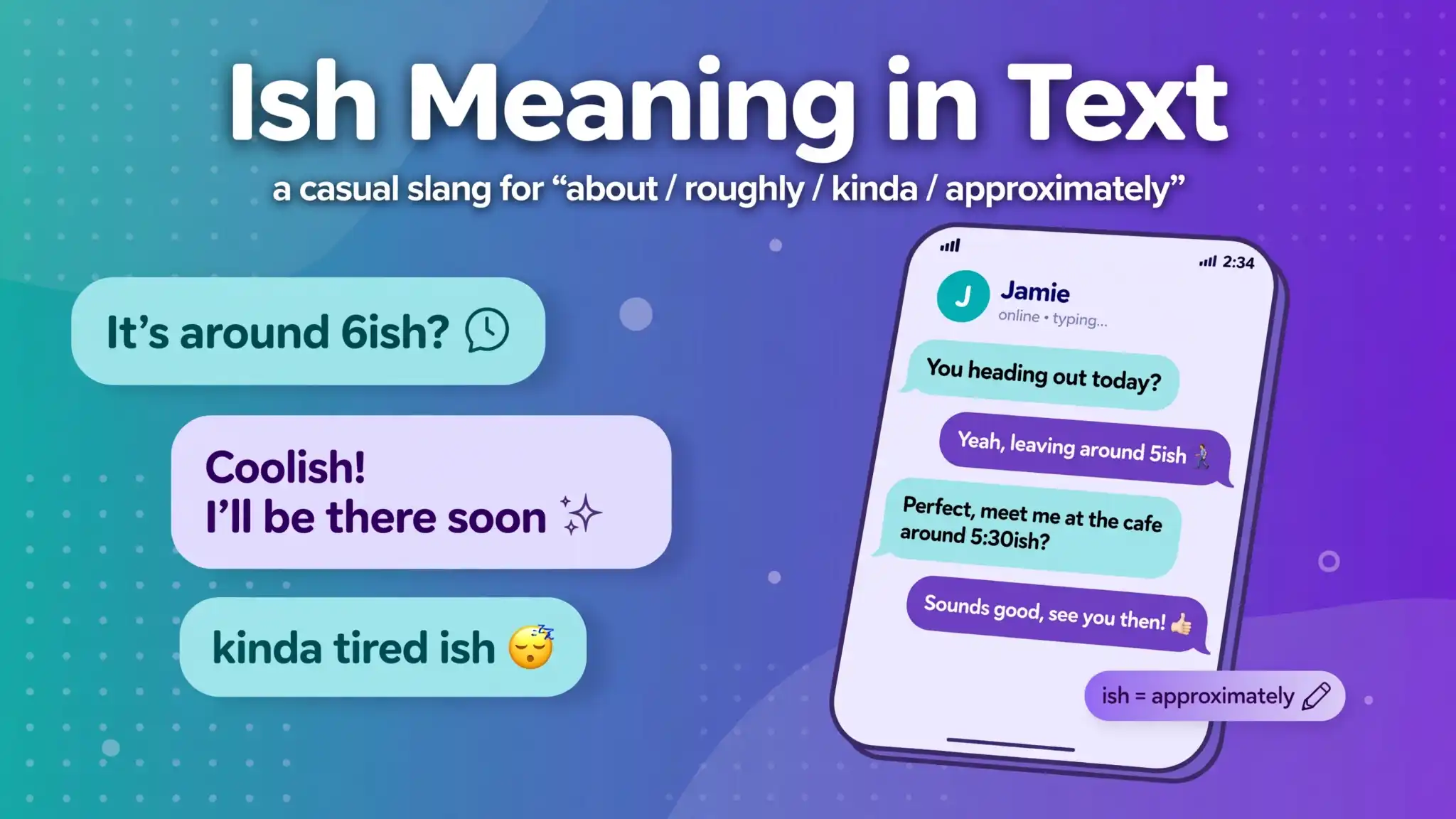
If someone texts you “7ish” or replies with just “ish,” they mean “kind of,” “sort of,” or “approximately.” That is the ish meaning in text: a tiny word that softens a statement so it does not sound too exact or too sure. It is one of the most common slang words in American texting.
People add “ish” to the end of words to make them vague on purpose. “Hungry-ish” means a little hungry. “Five-ish” means around five o’clock. As a standalone reply, “ish” usually means “maybe” or “not completely.”
In this guide, you will learn how “ish” works, when people use it, and the mistakes to avoid. You will also see where the word comes from and when it is better to use a clearer word instead.
Quick Answer
A quick way to remember the ish meaning in text: “ish” means “not exactly.” It turns a strong word into a soft one.
When it is stuck to the end of a word, it means “approximately” or “somewhat.” “Tallish” means somewhat tall. “Eight-ish” means around eight. When it stands alone as a reply, it means “maybe” or “sort of.” If you ask, “Are you ready?” and your friend texts back “Ish,” they mean “almost, but not fully.”
Dictionaries agree. Merriam-Webster defines the -ish suffix as “almost or approximately,” and the Cambridge Dictionary says “ish” is used when something is “not completely true or exactly right.”
Ish Meaning in Text
The ish meaning in text is simple: “ish” makes things less exact. It is a softener. Instead of giving a hard yes or a hard number, people use “ish” to leave a little room.
Think of it as a volume knob for words. “Funny” turned down a little becomes “funny-ish.” A firm “5 o’clock” turned down becomes “5-ish.” The speaker is telling you, “Do not take this as exact.”
This is why “ish” is so popular in texts and chats. Texting is fast and casual. People do not want to sound too strict or too sure about small things. “Ish” lets them be honest without being precise. It says, “This is close enough.”
The word can also stand completely alone. If someone asks, “Did you like the movie?” and you answer “Ish,” you mean “kind of” or “a little.” It is a gentle way to avoid a full yes or a full no. Once you hear it this way, you will start noticing “ish” everywhere in American conversations.
How “Ish” Works as a Suffix

Most of the time, “ish” is a suffix. A suffix is a small part added to the end of a word to change its meaning. The -ish suffix has been in English for a very long time. Merriam-Webster traces it back to Old English -isc, which is related to similar endings in German and Dutch.
Today, the suffix does three main jobs.
First, it means “approximately.” This is the most common job in texts. Add it to numbers and times: “sevenish,” “ten-ish,” “thirtyish.” It tells the reader, “This number is close, not exact.”
Second, it means “somewhat” or “a little like.” Add it to adjectives: “reddish” means a little red. “Tallish” means somewhat tall. “Tired-ish” means a little tired. The Cambridge Dictionary notes that we add -ish in informal settings to make things “deliberately vague.”
Third, it can show nationality or a group, like “English,” “Spanish,” or “Irish.” This is the oldest job of the suffix, and it works differently from the slang use. Nobody means “approximately England” when they say “English.”
Standalone “Ish” in Texts and Chats
Sometimes “ish” does not attach to any word at all. It stands alone as its own reply. This is where texting made it famous.
As a standalone answer, “ish” usually means “maybe,” “sort of,” or “not completely.” It is a soft yes or a soft no. Look at these real chat moments:
“Are you coming tonight?” — “Ish.” (Maybe. I am not sure yet.)
“Are you mad at me?” — “Ish.” (A little, but not really.)
“Did you finish your homework?” — “Ish.” (Almost done.)
Why do people answer this way? Because a full “yes” or “no” can feel too strong. “Ish” keeps things friendly. It tells the other person, “I hear you, and my answer is somewhere in the middle.” It is honest without starting a fight. That small reply carries a lot of social skill — it softens the message without lying.
One warning: in a serious talk, a lone “ish” can sound like you are dodging the question. If your friend asks something important, give them real words. Save “ish” for light, casual chats.
Real-Life Examples

“Ish” shows up in almost every kind of casual message. Here are the most common patterns, side by side so you can see the difference it makes.
| Without “ish” | With “ish” | What it really means |
|---|---|---|
| I will be there at 6. | I will be there at 6-ish. | Around 6, not exactly 6 |
| I am ready. | I am ready-ish. | Almost ready, still finishing up |
| She is tall. | She is tallish. | Somewhat tall, not very tall |
| The soup is hot. | The soup is hot-ish. | Warm, but not very hot |
| Are you okay? Yes. | Are you okay? Ish. | Sort of, not completely |
| It costs $20. | It costs $20-ish. | About $20, give or take a little |
You will notice a pattern. With numbers and times, “ish” almost always means “around.” With adjectives, it means “a little” or “somewhat.” As a reply on its own, it means “maybe.”
Many other words do a similar job. This table shows the closest matches and when to use each one.
| Word | Meaning | Example |
|---|---|---|
| ish / -ish | kind of, approximately (casual) | “See you at 8-ish.” |
| kind of | somewhat, to a degree | “I am kind of tired.” |
| sort of | similar to kind of | “It is sort of blue.” |
| about / around | approximately (numbers) | “About 20 people came.” |
| approximately | exactly “close to” (formal) | “Approximately 30 guests attended.” |
The second table shows words that do the same job. “Kind of” and “sort of” are the closest matches. “About” and “around” work well for numbers. “Approximately” means the same thing but sounds formal, so people rarely text it. “Ish” wins in chats because it is short, playful, and friendly.
Common Mistakes
Most people use “ish” correctly without thinking. But a few mistakes come up again and again.
The biggest one is using “ish” in formal writing. Do not put “ish” in a job application, a school essay, or a work email to your boss. Write “approximately” or “around” instead. “Ish” is for friends, not for formal papers.
Another mistake is stacking it where it does not fit. “Very-ish” and “really-ish” sound strange because “very” already means “a lot.” Pick one or the other.
Some learners also mix up “ish” with “the ish.” In some hip-hop slang, “the ish” is a censored way to say a swear word, as in “that song is the ish.” That is a completely different meaning, and it can confuse people. In normal texting, “ish” alone never means that.
Finally, do not overuse it. If every sentence ends with “ish,” your messages start to sound unsure about everything. Use it when you truly mean “approximately.”
When Not to Use “Ish”
“Ish” is perfect for casual chats, but some moments need clear words. Here is a simple rule: if being exact matters, skip the “ish.”
Do not use “ish” when giving directions to a driver, sharing a meeting time with your boss, or answering a doctor’s question. “Take the medicine at 8-ish” could mean 7:30 or 8:30, and that difference can matter. Say “at 8 o’clock” instead.
Also skip it when someone needs a clear yes or no. If a friend asks, “Can you help me move on Saturday?” answering “ish” will only confuse them. They need to plan. Give them a real answer, even if the answer is “I am not sure yet.”
In short, use “ish” to keep things light. Drop it when clarity counts more than comfort. Your friends will thank you for the honesty, and your boss will thank you for the precision.
FAQs
What does “ish” mean in text?
“Ish” means “kind of,” “sort of,” or “approximately.” It softens a word so it sounds less exact. “7ish” means around 7. A reply of just “ish” usually means “maybe” or “not completely.”
Is “ish” a real word?
Yes. As a suffix (-ish), it has been in English since Old English times, and dictionaries like Merriam-Webster and Cambridge list it. As standalone slang in texts, it is informal but widely used and understood.
Can “ish” go with any word?
Almost. It works best with adjectives (tallish), numbers (five-ish), and times (eight-ish). It sounds odd with words that are already extreme, like “perfect” or “huge” — “perfect-ish” is rare and usually a joke.
What does it mean when someone just replies “ish”?
It means “maybe,” “sort of,” or “close enough.” They are avoiding a hard yes or no. It is casual and friendly, but in a serious talk it can feel evasive.
Is “ish” okay to use at work?
In quick chats with coworkers you know well, sometimes. In emails, reports, or messages to your boss, no. Use “approximately,” “around,” or “about” instead.
Does “the ish” mean the same thing?
No. In some hip-hop slang, “the ish” is a censored version of a swear word meaning “the best,” as in “that beat is the ish.” That is a separate slang use and is not the same as the “approximately” meaning.
Conclusion
The ish meaning in text is easy to remember: “ish” means “not exactly.” It turns strong words soft, big numbers vague, and hard answers gentle. That tiny suffix carries a lot of social skill in just three letters.
Use it in casual chats when being close is good enough. Stick it on times, numbers, and adjectives, or drop it alone as a friendly “maybe.” Just keep it out of formal writing and serious talks, where clear words work better.
Once you understand “ish,” you will hear it everywhere — and you will know exactly how much wiggle room the speaker wants. It is one of those small slang words that makes English feel a little more human. Now you can use it with confidence.

Muhammad Haroon is the founder and writer behind Factnora.com, a platform focused on sharing interesting, useful, and reliable information. His work covers biographies, history, facts, and stories that help readers discover something new in a simple and engaging way. Through factnora, Muhammad aims to make learning enjoyable while presenting information in a clear and reader-friendly style.