Selling wolf tickets means making loud threats or big boasts that you do not plan to back up. It is like a dog that barks a lot but never bites.
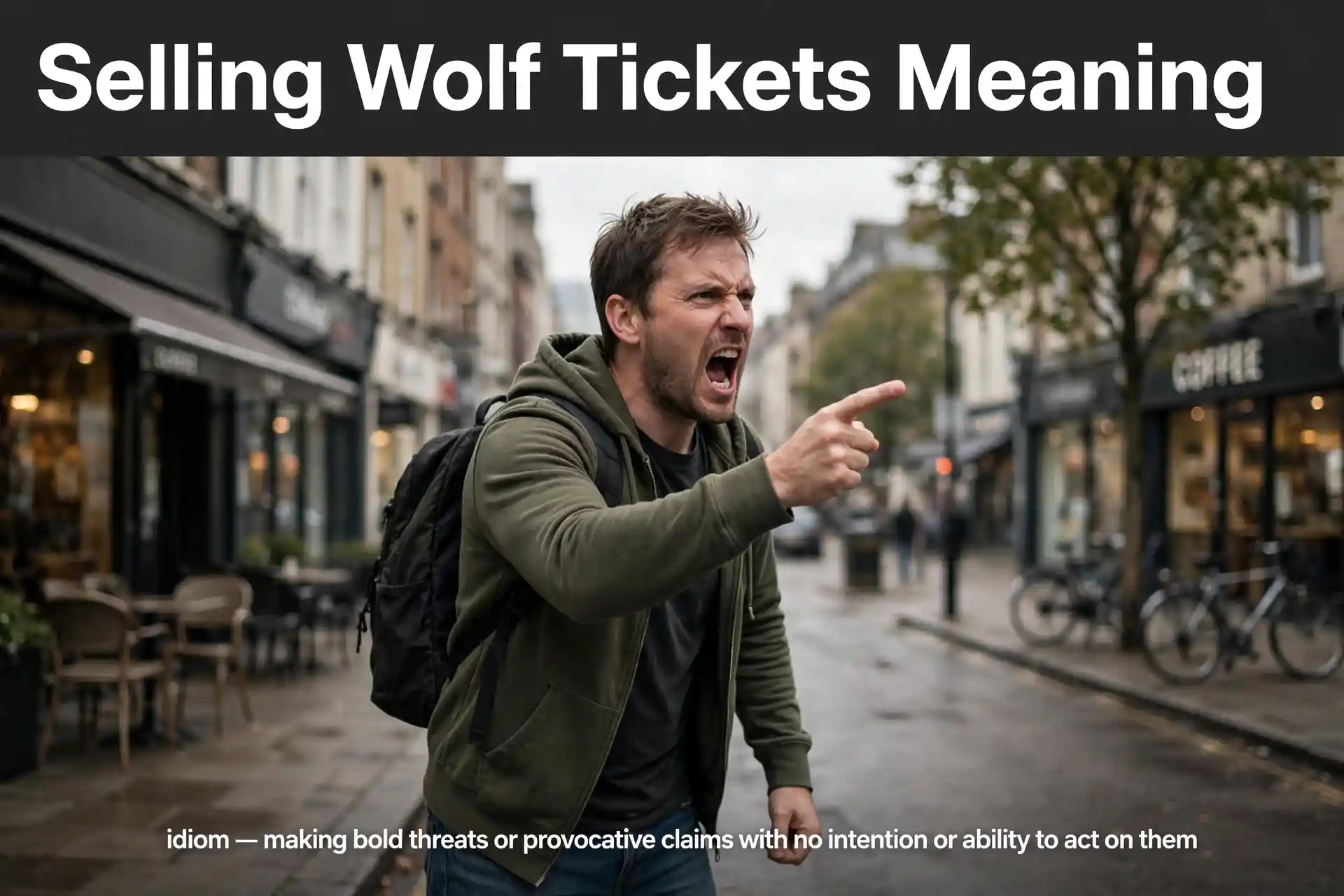
The selling wolf tickets meaning is simple: empty talk meant to scare or impress someone. If a person says, “I will knock you out,” but everyone knows he will not fight, he is selling wolf tickets.
You may hear this phrase in movies, hip-hop songs, or sports talk. It sounds funny at first, but it has real roots in African American culture and street language. In this guide, you will learn what the phrase means, where it came from, how people use it today, and the mistakes to avoid when you say it.
Quick Answer
To sell wolf tickets is to talk tough without acting tough. It means making threats, boasts, or big claims that are empty. The person wants to look strong or scare someone, but there is no real plan behind the words. A close phrase is “all bark and no bite.”
Selling Wolf Tickets Meaning
Let us break the phrase into pieces. “Selling” here does not mean a real sale. It means pushing an idea onto someone, the way a street seller pushes goods. “Wolf tickets” are the product, and the product is fake. There is no wolf. There never was a wolf. The tickets are worthless.
So when someone is selling wolf tickets, they are offering threats that have no value. They may yell, brag about what they will do, or act like they are dangerous. But it is all show. People who hear it usually know it is just talk.
Here are a few related phrases that work the same way:
| Phrase | What It Means |
|---|---|
| Sell wolf tickets | Make empty threats or boasts |
| Sell woof tickets | Same meaning; “woof” is the older form, like a dog’s bark |
| Buy wolf tickets | Believe someone’s empty threats; take the bluff seriously |
| Woofing | Talking tough to provoke or impress someone |
| All bark and no bite | Loud threats with no action behind them |
The flip side matters too. If you “buy” someone’s wolf tickets, you fall for the act. You treat the empty threat as real. Smart people learn not to buy wolf tickets. They stay calm and see the talk for what it is.
The phrase is informal and a bit edgy. You will hear it in casual talk, not in a business meeting. It fits conversations about sports, street life, arguments, and rap battles. Because it comes from Black American culture, it is good to use it with respect and not as a joke about the people who created it.
Where the Phrase Comes From
The selling wolf tickets meaning has deep roots. Language experts trace it to African American Vernacular English, the rich speech tradition of Black Americans. The key word is “woof,” which copies the sound of a dog barking.
To “woof” has meant to bluff or threaten with words since at least 1930. That year, the play Mule Bone, written by Zora Neale Hurston and Langston Hughes, used “woofing” for boastful talk. The Dictionary of American Regional English records this early use. So the idea of barking without biting is very old in Black speech.
The full phrase showed up later. Sociologists first wrote it down in 1963 after hearing Black gang members in Chicago use it. They had heard it in speeches two years earlier, so people were surely saying it on the street before that. The written form was “wolf,” but many experts think the original word was “woof.” White researchers may have simply misheard it. By the 1970s, “sell woof tickets” was recorded in its own right.
Some people guess the phrase comes from the story of the boy who cried wolf. That is possible, but language experts say there is no strong proof. The “woof as a bark” idea fits better, because the whole point is noise without action.
From the streets, the phrase moved into wider American culture. Hip-hop artists used it in songs. The TV show The Fresh Prince of Bel-Air mentioned it. MMA fighter Nick Diaz used it at a press conference to say a fight was overhyped. Each time, the meaning stayed the same: big talk, no action.
How People Use It Today
Today, selling wolf tickets is not just about street fights. People use it for any empty boast. A company that promises a great product and delivers junk is selling wolf tickets. A politician who makes big promises with no plan is selling wolf tickets. A friend who brags about running a marathon but never trains is selling wolf tickets.
Sports talk is full of it. Before a big game, players trash-talk each other. Fans love it, but they know most of it is wolf tickets. After the game, the score tells the truth. The phrase is a fun way to call out hype.
On social media, the phrase pops up in comments and posts. Someone might write, “He’s just selling wolf tickets,” under a video of a man yelling at another driver. It is a quick way to say, “Do not take this seriously.”
The phrase also shows up in its “buying” form. “I don’t buy wolf tickets” means “You cannot scare me with empty words.” It is a confident reply. It says the speaker sees through the act.
Here is how the phrase shows up in different parts of life:
| Setting | What Selling Wolf Tickets Looks Like There |
|---|---|
| Sports | Trash talk before a game that the final score proves wrong |
| Advertising | Big product claims the real product cannot match |
| Arguments | Loud threats the person never acts on |
| Politics | Grand promises with no real plan behind them |
| Social media | Angry comments meant to scare, with no follow-through |
One thing has not changed: the phrase is still informal. Do not use it in a job interview, a school essay, or a formal email. Save it for casual talk with people who know slang.
Real-Life Examples
Examples make the selling wolf tickets meaning clear. Here are everyday situations:
Example 1: The parking lot argument. Two drivers argue over a parking spot. One shouts, “Get out of the car and say that to my face!” He stays in his car and drives away. He was selling wolf tickets.
Example 2: The office bragger. A coworker says, “I could do the boss’s job better than him.” But he never applies for the role and never speaks up in meetings. His coworkers smile. They know he is selling wolf tickets.
Example 3: The hyped product. A phone company runs ads saying its new phone will “change everything.” When it comes out, it is just like last year’s model. The ads were selling wolf tickets.
Example 4: The sports bet. A fan tells everyone his team will win by 30 points. The team loses. His friends laugh and say, “Stop selling wolf tickets.”
Example 5: The smart reply. A stranger tries to scare a woman by saying, “You don’t want trouble with me.” She answers calmly, “I don’t buy wolf tickets.” She is saying his threats mean nothing to her.
Notice the pattern. In each case, big words meet zero action. That gap is the heart of the phrase.
Common Mistakes
Thinking it is about real wolves. There is no wolf in this phrase. It is about empty threats, not animals. Do not explain it with wolf facts.
Using “buy” and “sell” backwards. Selling wolf tickets means making the threats. Buying wolf tickets means believing them. Mix these up and your sentence will confuse people.
Saying it in formal settings. This is street slang. It will sound wrong in a work presentation or a college paper. Match the phrase to casual moments.
Forgetting the culture behind it. The phrase comes from Black American speech. Using it is fine, but do not mock the accent or treat it as a joke about Black people. Respect the source.
Spelling it “woof” or “wolf” and worrying too much. Both forms exist. “Wolf tickets” is more common in writing today. “Woof tickets” is closer to the original. Either one will be understood.
Assuming every threat is wolf tickets. Sometimes people mean what they say. The phrase is for threats that are clearly empty. If someone might really act, do not brush it off. Take real danger seriously and get help if you need it.
Tips or Best Practices
If you want to use the phrase well, follow these tips.
First, use it to describe the talk, not the person, when you can. “That was wolf tickets” sounds lighter than “You are a wolf-ticket seller.” It keeps things friendly.
Second, read the room. With friends who know slang, it gets a laugh. With people who do not know it, you will need to explain. If you must explain, say, “It means empty threats, like all bark and no bite.”
Third, never use it to dismiss a real threat. If someone threatens harm and you feel unsafe, do not call it wolf tickets and walk away. Tell someone you trust or call for help. Words can be a warning sign.
Fourth, enjoy its flavor. The phrase has rhythm and history. Using it connects you to a long line of clever American speech, from 1930s plays to modern hip-hop. That is worth appreciating.
Finally, pair it with its partner phrases. “He sold wolf tickets, but nobody bought them” is a complete little story. It says someone bragged and everyone saw through it. Short, clear, and fun.
FAQs
What does selling wolf tickets mean?
It means making loud threats or boasts you do not intend to back up. It is empty talk meant to scare or impress, like a dog that barks but never bites.
Where did the phrase come from?
It comes from African American Vernacular English. “Woof” copies a dog’s bark, and “woofing” has meant bluffing since at least 1930. Sociologists recorded “selling wolf tickets” among Black Chicagoans in the early 1960s.
Is it “wolf tickets” or “woof tickets”?
Both are used. “Wolf tickets” is more common in writing now. “Woof tickets” is likely the older, original form. People will understand either one.
What does “buy wolf tickets” mean?
It means believing someone’s empty threats or taking their bluff seriously. Saying “I don’t buy wolf tickets” means their tough talk does not scare you.
Is selling wolf tickets always about fighting?
No. Today people use it for any empty boast: hyped products, big promises, sports trash talk, or bragging friends. The core idea is big words with no action.
Can I use this phrase at work?
Probably not. It is informal slang. Save it for casual conversation, and never use it to dismiss a threat that might be real.
Conclusion
The selling wolf tickets meaning is easy to remember: loud threats with nothing behind them. It is the bark without the bite, the big sale with no product.
The phrase grew out of Black American speech, where “woofing” meant bluffing as far back as 1930, and it was written down among Chicagoans in the early 1960s.
Today the phrase lives far beyond the street corner. You hear it in sports debates, product reviews, song lyrics, and comment sections. Wherever people hype things up with empty words, someone is selling wolf tickets.
Now you know what it means, where it came from, and how to use it right. Next time you hear big talk, ask yourself one question: is there a bite behind that bark?

Muhammad Haroon is the founder and writer behind Factnora.com, a platform focused on sharing interesting, useful, and reliable information. His work covers biographies, history, facts, and stories that help readers discover something new in a simple and engaging way. Through factnora, Muhammad aims to make learning enjoyable while presenting information in a clear and reader-friendly style.