The third time’s a charm meaning is simple: if something fails twice, people often believe the third attempt may succeed. It is a common English saying used to express hope, luck, and persistence. You may hear it when someone tries something again after two unsuccessful attempts.
For example, if you try to fix your computer twice and finally get it working on the third attempt, someone might smile and say, Well, third time’s a charm! The phrase is usually lighthearted and does not mean that success is guaranteed.
In this guide, you will learn what third time’s a charm means, where the saying comes from, how to use it correctly, and what it means in everyday conversations. You will also see simple examples and learn why the number three appears so often in this expression.
Quick Answer: What Does Third Time’s a Charm Mean?
Third time’s a charm means that after two failed attempts, the third attempt is expected or hoped to be successful.
It is an informal English idiom. People often say it when they are about to try something for the third time.
For example:
I failed the driving test twice, but third time’s a charm!
The speaker is saying that they hope the third attempt will finally work.
The phrase does not promise success. It is usually a cheerful way to stay positive after something has gone wrong.
| Phrase | Simple meaning |
| Third time’s a charm | The third attempt may succeed |
| Try again | Make another attempt |
| Better luck next time | Hope for better results in the future |
| Never give up | Keep trying despite failure |
Third Time’s a Charm Meaning in Simple Words
In simple words, third time’s a charm means Maybe it will work this time.
Imagine that you are trying to bake a cake. The first cake burns. The second cake does not rise. You change your method and try one more time.
As you put the third cake in the oven, your friend says, Third time’s a charm!
Your friend is not saying that the third cake must be perfect. They are expressing hope that your third attempt will finally succeed.
The phrase can be used for both serious and funny situations. It may describe a job interview, a sports attempt, a repair, a test, a date, or even something as small as opening a difficult jar.
The main ideas behind the saying are persistence, hope, luck, and another chance.
Is Third Time’s a Charm an Idiom?

Yes. Third time’s a charm is an English idiom.
An idiom is a phrase whose meaning is different from the exact meaning of its individual words.
If you take the phrase literally, it sounds as if the number three has a special magical power. But that is not what most speakers mean.
Instead, charm means something that is believed to bring good luck or help create a positive result. In this expression, the third attempt is described as lucky or promising.
The saying is normally used in a casual and friendly way. It is common in everyday American English.
| Word or phrase | Meaning in this expression |
| Third | The third attempt |
| Time | An occasion or attempt |
| Charm | Something believed to bring good luck |
| Third time’s a charm | Hope that the third attempt will succeed |
Where Did Third Time’s a Charm Come From?
The exact origin of third time’s a charm is not completely certain.
However, the idea that the number three is special is very old. Groups of three appear in many stories, sayings, traditions, and forms of storytelling. Three often creates a sense of completion: something happens once, happens again, and then reaches a final result.
Older English expressions also used the number three when talking about luck or success. One related saying is the third time pays for all, which appeared in older English usage and carried the idea that a third attempt could make up for earlier failures.
The modern phrase developed over time from this broader belief in the power or luck of three.
It is important not to claim that one person invented the saying unless reliable historical evidence supports that claim. The expression has developed through common language and tradition.
Why Is the Number Three Important?
The number three has a strong place in language and storytelling.
People often remember things in groups of three. Stories may have three major events. Speakers may repeat an idea three times for emphasis. Many familiar expressions also use three because it creates a natural rhythm.
This may help explain why the idea of a third attempt feels satisfying.
Think about these simple patterns:
Ready, set, go.
Stop, look, and listen.
Life, liberty, and the pursuit of happiness.
A pattern of three can feel complete and easy to remember.
The same idea appears in third time’s a charm. The first attempt fails. The second attempt fails. The third attempt becomes the hopeful moment when things may finally go right.
This does not mean three is scientifically luckier than other numbers. The importance of three here is mainly cultural and linguistic.
Third Time’s a Charm Meaning and Persistence

One reason people like this saying is that it encourages persistence.
Failure can make people want to stop. When someone says third time’s a charm, they are often encouraging another try.
For example, imagine a student who gets a low score on two practice tests. Instead of giving up, the student studies the difficult topics and takes another practice test.
A teacher might say, Keep going. Third time’s a charm.
The phrase makes the situation sound less discouraging. It turns another attempt into a hopeful opportunity.
Of course, simply trying something again does not always produce a better result. In real life, success often requires learning from mistakes, changing your approach, or getting more practice.
So the deeper lesson can be more useful than the literal saying: keep trying, but learn from what happened before.
How to Use Third Time’s a Charm in a Sentence
The phrase is usually placed near the beginning or end of a sentence.
Here are some natural examples:
I missed the bus twice, but third time’s a charm.
I’ve tried to call her two times already. Third time’s a charm.
We lost our first two games, but third time’s a charm.
I couldn’t fix the printer yesterday or this morning. Third time’s a charm!
In casual speech, you can also use the phrase by itself:
Third time’s a charm!
This works especially well when everyone already knows that something has failed twice.
The phrase is informal, so it is more suitable for conversations, texts, social media, and casual writing than for formal business or academic writing.
Third Time’s a Charm Grammar and Correct Usage
The standard expression is third time’s a charm.
The word time’s is a contraction. In this phrase, it means time is.
So the full idea is:
The third time is a charm.
However, native speakers commonly use the shorter form:
Third time’s a charm.
You may also see third time is the charm or the third time’s the charm. These versions are understandable, but third time’s a charm is the familiar idiomatic form.
| Version | Usage |
| Third time’s a charm | Common and natural |
| The third time’s a charm | Also understandable |
| The third time is the charm | Clear, but less idiomatic |
| Third time is charm | Incorrect grammar |
The important point is to keep the phrase natural. In casual conversation, Third time’s a charm! is usually the easiest choice.
Third Time’s a Charm vs. Third Time Is the Charm
These expressions have nearly the same meaning.
Third time’s a charm is the more familiar idiom. The third time is the charm explains the same idea in a slightly more complete form.
For example:
I failed twice, but third time’s a charm.
I failed twice, but the third time is the charm.
Both sentences tell the listener that the speaker hopes the third attempt will succeed.
The first version sounds more natural in everyday conversation because it is short and familiar.
Real-Life Examples of Third Time’s a Charm
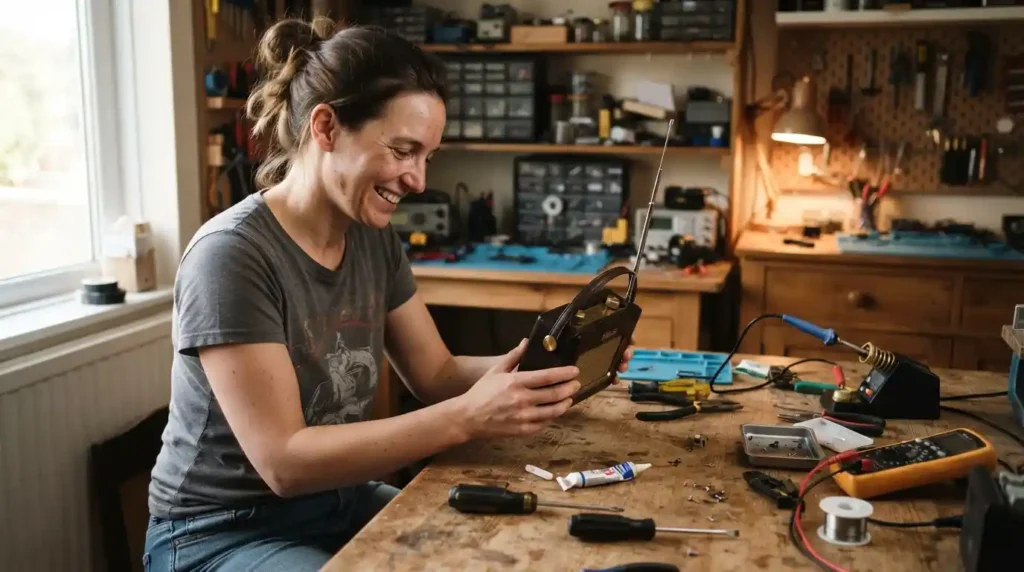
The saying can fit many everyday situations.
Imagine someone trying to start a lawn mower. It does not start the first time. It also fails on the second try. On the third attempt, the engine starts.
Third time’s a charm!
Or imagine a person applying for jobs. They receive two rejection emails before getting an interview with the third company.
They might say, I guess third time’s a charm.
The phrase can also be funny.
Someone may try three times to take the perfect family photo because someone keeps blinking. Before taking the third photo, they say, Okay, third time’s a charm!
Here are more examples:
| Situation | Example |
| Cooking | The first two cakes failed. Third time’s a charm! |
| Exams | I didn’t pass twice, but third time’s a charm. |
| Sports | He missed two shots. Third time’s a charm. |
| Repairs | I’ve restarted it twice. Third time’s a charm. |
| Travel | Our first two flights were canceled. Third time’s a charm. |
| Everyday tasks | I couldn’t open it twice. Third time’s a charm! |
Is Third Time’s a Charm Always About Luck?
Not necessarily.
The phrase often has a connection to luck, but people do not always use it seriously. Sometimes it is simply a fun way to express hope.
For example, someone may say third time’s a charm while trying something for the third time even though they know there is no special reason the third attempt should work.
In other situations, the speaker may genuinely feel lucky.
The important thing is that the phrase expresses optimism after earlier failure.
It can also carry a small message of encouragement: Don’t give up yet.
Is Third Time’s a Charm Positive or Negative?
The phrase is generally positive.
It recognizes that the first two attempts did not work, but it focuses on the possibility of success on the third attempt.
That makes it a hopeful expression.
For example, saying I failed twice focuses on the past. Saying Third time’s a charm focuses on what might happen next.
This is why people often use the expression when someone feels disappointed.
It can make a frustrating situation feel lighter and more hopeful.
Common Mistakes With Third Time’s a Charm
One common mistake is taking the phrase too literally.
The expression does not mean that the third attempt will definitely succeed. It simply suggests that the third try may be successful.
Another mistake is using it in a very formal situation. While the phrase is easy to understand, it is an informal idiom. A formal report might use clearer language such as The third attempt was successful.
Some writers also confuse charm with a physical object. In this idiom, charm refers to the idea of good luck, not necessarily a necklace, bracelet, or other lucky object.
The best way to use the phrase is in situations where the tone is relaxed, hopeful, or playful.
Similar Expressions to Third Time’s a Charm
English has several sayings that express ideas similar to third time’s a charm.
Never give up focuses on continuing despite difficulties.
If at first you don’t succeed, try, try again has a very similar message. It encourages people to keep trying after failure.
Better luck next time is another common expression, but it is usually said after something has already gone wrong.
Third time’s a charm is different because it specifically focuses on the third attempt.
| Expression | Main idea |
| Third time’s a charm | The third attempt may succeed |
| Never give up | Keep going |
| Try, try again | Make another attempt |
| Better luck next time | Hope for success in the future |
| If at first you don’t succeed | Failure does not mean you should stop |
When Should You Use Third Time’s a Charm?
Use the phrase when someone is making a third attempt at something and you want to express hope or encouragement.
It works well with friends, family members, classmates, coworkers, and other people in casual settings.
For example:
Your friend is trying to fix a bicycle.
You watch them try twice.
On the third attempt, you say, Third time’s a charm!
That sounds natural because the situation matches the meaning of the expression.
You can also use it when talking about your own situation:
I’ve applied to two schools already. Third time’s a charm!
The phrase adds a positive and slightly playful tone.
FAQs
What does third time’s a charm mean?
It means that after two unsuccessful attempts, the third attempt may finally succeed. It expresses hope, optimism, or the idea of good luck.
Is third time’s a charm a saying or an idiom?
It is an idiomatic English saying. The words do not need to be understood literally. The phrase means that the third try is hoped to be successful.
Is third time’s a charm formal or informal?
It is informal. It is best for casual conversations, messages, social media, and friendly writing. More formal writing can simply say that the third attempt succeeded.
Does third time’s a charm mean the third attempt will always work?
No. The phrase does not guarantee success. It is a hopeful expression that suggests the third attempt might go better than the first two.
Can I say third time’s a charm after only one failure?
Usually, no. The expression is normally used when something has already been attempted twice and someone is about to try it for the third time.
What is another way to say third time’s a charm?
You can say try again, never give up, or if at first you don’t succeed, try again. These expressions share the general idea of continuing after failure.
Conclusion
The third time’s a charm meaning is the idea that a third attempt may succeed after the first two attempts have failed. It is a common, informal English idiom that expresses hope, persistence, and sometimes a sense of luck.
The saying does not mean that the number three has magical power or that success is guaranteed. Instead, it gives people a positive way to look at another attempt.
If you use the phrase in everyday conversation, keep the tone casual and hopeful. When someone has already tried twice, Third time’s a charm! is a natural way to encourage them to give it one more try.
Sometimes the third attempt works. Sometimes it does not. Either way, the phrase reminds us that one failure does not always mean the end.

Ali Sher is a writer and the creator of Factnora.com, a website dedicated to sharing fascinating facts, biographies, history, and useful knowledge. He enjoys researching interesting topics and turning them into simple, engaging stories for readers. Through factnora, Muhammad aims to provide informative content that is easy to understand, enjoyable to read, and worth sharing.