The all’s fair in love and war meaning is that people sometimes believe normal rules of behavior can be set aside when they are fighting for love or trying to win a conflict.
In simple words, the saying suggests that almost any tactic may be seen as acceptable in these two situations.
However, it is usually used as a saying, not as a rule that excuses harmful or dishonest behavior.
Quick Answer
All’s fair in love and war means that people may use unusual, clever, or even questionable methods when trying to win someone’s love or succeed in a serious conflict.
For example, someone might say this after using a clever trick to impress a person they like. The phrase can also describe people who use aggressive strategies against an opponent.
The saying is often used playfully or humorously, especially in everyday conversation. It does not always mean that everything is truly acceptable. In many situations, people use it to explain or defend behavior that would normally be considered unfair.
| Phrase | Simple meaning |
| All’s fair in love and war | Anything may seem acceptable when trying to win love or a conflict |
| Love | Romantic relationships or courtship |
| War | A serious fight or conflict |
| Fair | Acceptable or allowed in the context |
Meaning or Definition of All’s Fair in Love and War
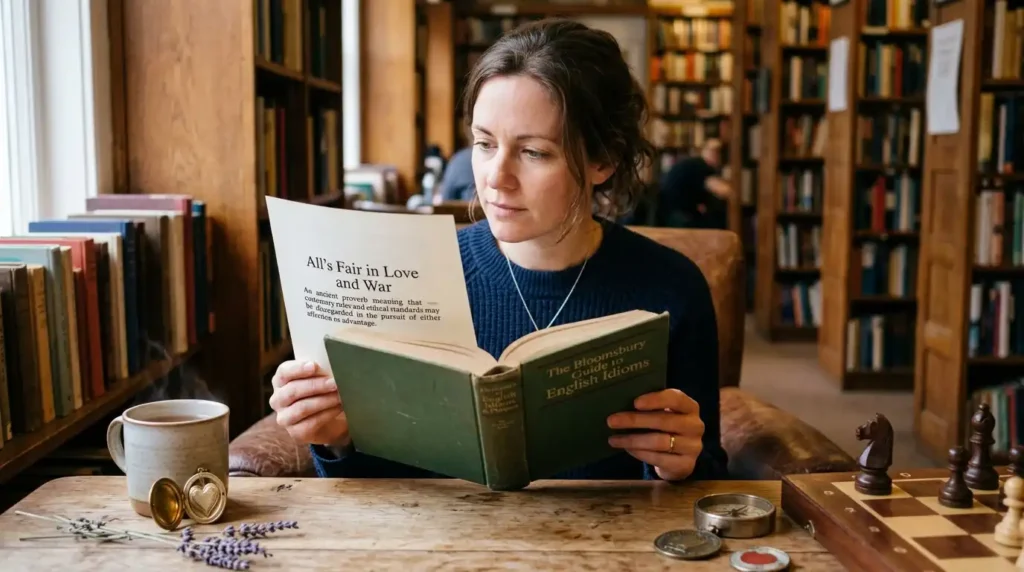
The phrase all’s fair in love and war is an idiom. An idiom is an expression whose meaning is different from the literal meaning of its individual words.
If you take the phrase literally, it sounds like every action is fair during romance and war. But that is not usually what the speaker is trying to say.
Instead, the phrase points to the idea that strong competition can make people behave differently from normal. When people strongly want something, they may take risks, use clever plans, or break ordinary social rules.
Imagine two people trying to get the same job. One person prepares very hard and gives an excellent interview. The other finds a creative way to stand out. Someone might jokingly say, All’s fair in love and war, even though the situation is not actually about love or war.
The expression can therefore be used more broadly to talk about competition.
The important point is that the phrase describes a belief or attitude. It does not automatically make an action ethical, kind, legal, or harmless.
What Does All’s Fair in Love and War Really Imply?
The phrase often suggests that the goal can become more important than the usual rules.
In romantic situations, a person may try different ways to get someone’s attention. They might dress differently, write a thoughtful message, or make an unusual romantic gesture.
In a conflict, people may use strategy, surprise, or deception to gain an advantage.
The phrase puts these situations together because both can involve strong emotions, competition, and a desire to win.
Still, context matters.
If someone uses the phrase after doing something harmless and clever, it may sound funny. If someone uses it to defend lying, cheating, manipulation, or cruelty, the statement becomes much more serious.
| Situation | Example | Possible use of the phrase |
| Dating | Someone makes an impressive romantic gesture | Playful |
| Competition | A team uses an unexpected strategy | Lighthearted |
| Business | A company tries an unusual marketing idea | Figurative |
| Conflict | An opponent uses a strategic trick | More serious |
| Harmful behavior | Someone excuses lying or betrayal | Controversial |
Grammar and Correct Usage
The standard form is:
All’s fair in love and war.
Here, all’s is a contraction of all is.
So the full version is:
All is fair in love and war.
The shorter version is much more common in everyday speech and writing.
The phrase can be used at the beginning, middle, or end of a sentence.
For example:
He sent her flowers every day. All’s fair in love and war.
You took the last ticket before I could buy it? Well, all’s fair in love and war.
She used a clever strategy to get the contract. All’s fair in love and war.
It is usually best to use the phrase when the context involves competition, romance, conflict, or trying to gain an advantage.
Because it is an idiom, you normally should not change the words. Saying something like everything is fair in love and war may communicate the same general idea, but it is not the traditional expression.
Origin and History of the Phrase
The exact history of all’s fair in love and war is not completely simple. Similar ideas appeared in older writing before the modern form became common.
The concept behind the saying is much older than the exact wording. For centuries, writers and speakers have discussed the idea that normal rules may be treated differently during war or intense competition.
The modern phrase is often connected with the broader European tradition of sayings about love and conflict. Similar expressions existed in other languages and cultures.
One important historical point is that the phrase should not be treated as a literal legal or moral principle. It is a figure of speech that describes an attitude toward competition.
The wording became widely recognized in English over time, and today it is familiar in books, movies, television, conversations, and online writing.
Because historical sources use related versions and ideas, it is safer to explain the phrase as having older roots in the idea that love and war can change ordinary rules, rather than claiming that one specific person definitely invented the exact modern expression.
Why Are Love and War Compared?

At first, love and war may seem like completely different subjects. One is connected with affection and relationships, while the other involves armed conflict.
The phrase connects them because both have traditionally been described as areas where people may compete intensely.
In romantic relationships, someone may compete for another person’s attention or affection. In war, opposing sides compete to achieve their goals.
Both can involve planning, emotion, risk, surprise, and strong personal interests.
That does not mean the two situations are morally equal. Modern readers should understand the phrase as a comparison about competition and strategy, not as a statement that romance and war are the same thing.
Real-Life Examples of All’s Fair in Love and War
Understanding the phrase becomes easier when you see how people use it.
Imagine two friends both like the same person. One friend plans a thoughtful dinner and asks the person on a date. The other friend jokes, All’s fair in love and war.
Here, the phrase is probably being used in a light and playful way.
Now imagine two sports teams are competing for a championship. One team uses an unexpected strategy that surprises its opponent. A fan might say, All’s fair in love and war.
Again, the expression is being used figuratively.
It can also appear in business conversations. If two companies compete for customers, someone may use the phrase to describe aggressive competition.
These examples show that the expression is not limited to actual war.
Examples in Everyday Sentences
Here are some natural examples:
You asked her out before I did? All’s fair in love and war.
They came up with a clever plan to win the contest. All’s fair in love and war.
He bought the last concert ticket before I could. I guess all’s fair in love and war.
She surprised her rival with a new strategy. All’s fair in love and war.
I know it was a competitive move, but all’s fair in love and war.
The tone changes depending on the situation. In casual conversation, the phrase can sound humorous. In a serious discussion, it may sound like an attempt to justify questionable behavior.
Is All’s Fair in Love and War Positive or Negative?
The phrase itself is not always positive or negative. Its meaning depends heavily on who says it, why they say it, and what happened before it.
Someone may use it jokingly after winning a harmless competition.
For example, if two siblings race to get the last cookie, one might jokingly say, All’s fair in love and war.
But the phrase can also be used critically. If someone lies to another person and then says, All’s fair in love and war, the listener may feel that the speaker is trying to excuse bad behavior.
So, the expression can carry different tones:
| Tone | Meaning |
| Humorous | I found a clever way to win. |
| Playful | We were competing, so I tried hard. |
| Defensive | I know what I did was questionable, but I wanted to win. |
| Serious | Competition can lead people to ignore normal rules. |
This is why understanding the context is important.
What Does It Mean in a Relationship?

When used in dating or relationships, all’s fair in love and war often means that people may try different ways to attract someone they love.
For example, a person might make a bold romantic gesture or find a creative way to ask someone on a date.
However, the phrase should not be taken as permission to ignore another person’s boundaries.
Healthy relationships still depend on honesty, respect, consent, and trust. The expression is an idiom, not a relationship rulebook.
If someone uses the phrase to defend stalking, coercion, deception, or emotional abuse, the saying does not make those actions acceptable.
This distinction is especially important because old expressions can sometimes be used in ways that do not fit modern ideas about healthy relationships.
Common Mistakes
One common mistake is believing that the phrase means everything is literally acceptable.
That is too broad.
Another mistake is using it in a situation where there is no competition, conflict, or connection to winning.
For example, if someone forgets a friend’s birthday, saying all’s fair in love and war does not naturally explain the situation.
People also sometimes confuse the phrase with other sayings about competition. Although the ideas may overlap, all’s fair in love and war has its own traditional wording and meaning.
Finally, remember that the expression can be humorous. A speaker may not seriously believe that every action is acceptable. They may simply be making a joke about competition.
British vs. American English
The expression all’s fair in love and war is understood in both British and American English.
There is no major difference in its basic meaning between the two varieties of English.
The contraction all’s is also understood in both forms of English.
However, the phrase may appear in different contexts depending on the speaker. British and American speakers can use it casually, especially when talking about dating, competition, games, business, or rivalry.
Because it is a well-known idiom, an English speaker from either country will generally understand the intended meaning.
Similar Expressions
English has several expressions that communicate related ideas.
For example, It’s a dog-eat-dog world describes a highly competitive environment in which people may strongly pursue their own interests.
May the best man win is different because it usually expresses a wish that the strongest or most deserving competitor will succeed.
By any means necessary can sound much stronger. It suggests a willingness to use whatever methods are needed to reach a goal.
These expressions should not be treated as exact synonyms.
| Expression | Main idea |
| All’s fair in love and war | Competition can lead people to ignore normal rules |
| Dog-eat-dog world | Life or business can be extremely competitive |
| May the best man win | Let the strongest competitor succeed |
| By any means necessary | Use whatever methods are needed |
| Fight fire with fire | Respond to a difficult tactic with a similar tactic |
FAQs
What is the simple meaning of all’s fair in love and war?
It means that people may believe unusual or questionable tactics are acceptable when trying to win love or succeed in a conflict.
Is all’s fair in love and war an idiom?
Yes. It is an English idiom. Its meaning is broader than the literal meaning of its individual words.
What does all’s mean?
All’s is a contraction of all is. The complete version is All is fair in love and war.
Can I use this phrase in everyday conversation?
Yes. It is commonly used in casual conversation, especially when talking about competition, dating, rivalry, or trying to gain an advantage.
Does the phrase mean that anything is actually acceptable?
Not necessarily. It is a saying that describes an attitude toward competition. It does not make harmful, dishonest, illegal, or abusive behavior acceptable.
Is all’s fair in love and war still used today?
Yes. English speakers still use the phrase, especially in informal conversation, popular culture, writing, and humorous situations.
Conclusion
The all’s fair in love and war meaning is simple: people may believe that normal rules can be relaxed when they are trying hard to win love or succeed in a serious conflict. The phrase is an old English idiom, but people still use it today in everyday conversation.
The most important thing to remember is that the phrase is descriptive, not a literal rule. It does not automatically make every action fair or acceptable. In modern relationships and everyday life, honesty, respect, and healthy boundaries still matter.
When you hear someone say all’s fair in love and war, look at the context. That will usually tell you If the speaker is making a joke, describing competition, or defending a questionable choice.

Muhammad Haroon is the founder and writer behind Factnora.com, a platform focused on sharing interesting, useful, and reliable information. His work covers biographies, history, facts, and stories that help readers discover something new in a simple and engaging way. Through factnora, Muhammad aims to make learning enjoyable while presenting information in a clear and reader-friendly style.