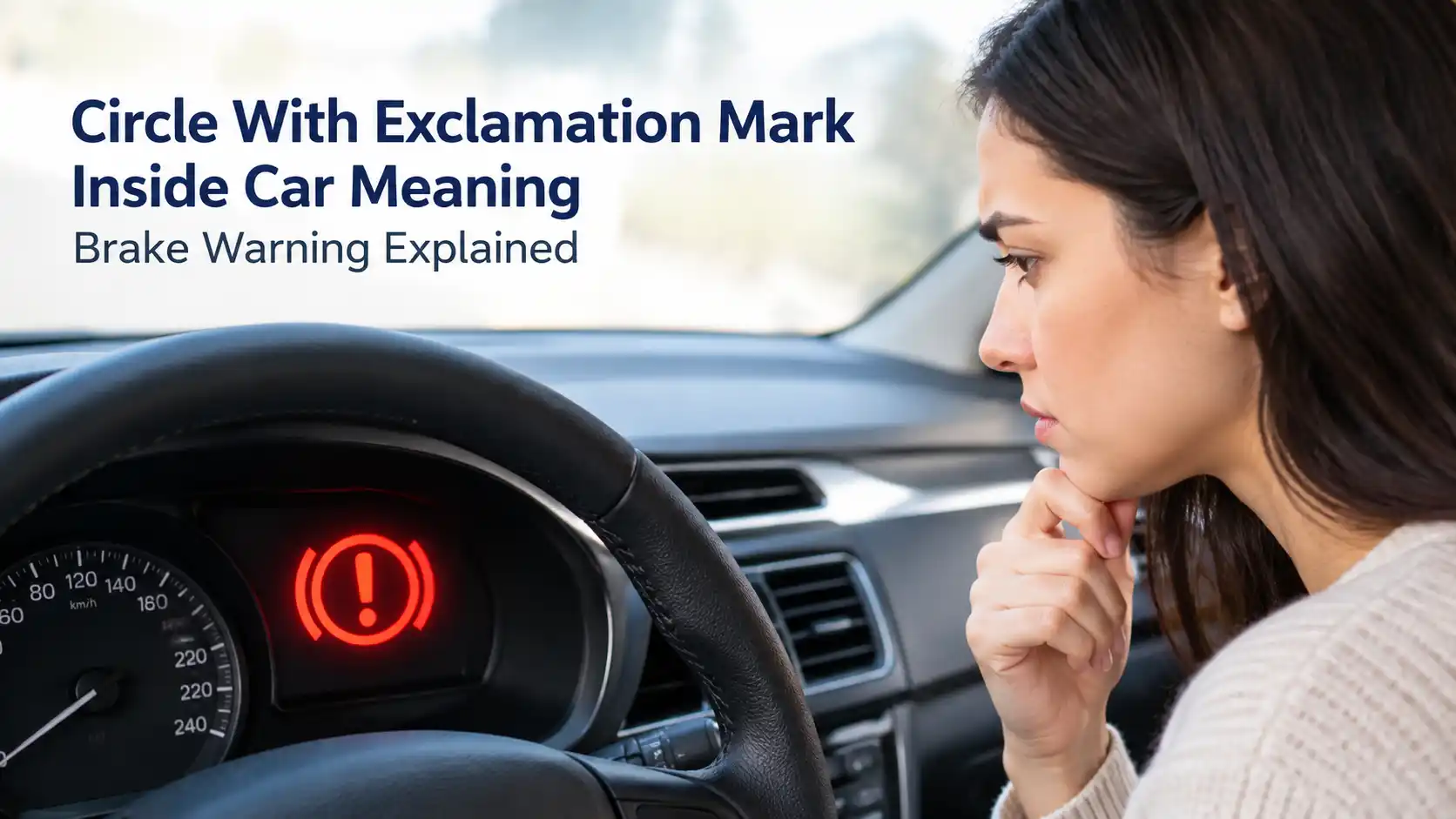
Seeing a circle with an exclamation mark inside your car usually means there is a brake system warning. Depending on the vehicle, it can mean the parking brake is on, brake fluid is low, or there is a problem with the braking system.
Because brakes are a major safety system, this warning should not be ignored. If the light appears briefly when you start the car and then goes away, it may simply be part of the normal dashboard system check.
If it stays on while driving, however, you should check the owner’s manual and take the warning seriously. The exact meaning can vary by make, model, and year.
Quick Answer: What Does the Circle With an Exclamation Mark Mean?
The circle with an exclamation mark inside car meaning is most often connected to the vehicle’s brake system. It is commonly called the brake warning light.
The warning may appear as a red circle containing an exclamation mark. Some vehicles use the word “BRAKE” instead of the symbol. Other cars may use a similar symbol for the parking brake or another brake-related warning. Toyota manuals, for example, identify a red circle/exclamation symbol as a brake system warning light on some vehicles.
Here are some common reasons the light may appear:
| Possible reason | What it may mean |
| Parking brake is on | The parking brake has not been fully released |
| Low brake fluid | The brake fluid level may be below the required level |
| Brake system problem | A part of the braking system may need inspection |
| Electric parking brake issue | The electronic parking brake may have a fault |
| Normal startup check | The light briefly appears when the car is started |
The most important point is simple: do not assume the warning is harmless if it stays on while you are driving.
Why Is There an Exclamation Mark Inside a Circle?
Dashboard symbols are designed to communicate important information quickly. The circle-and-exclamation symbol is commonly associated with the brake system.
The exact design is not identical in every vehicle. Some dashboards show a circle around the exclamation mark. Others may show the word “BRAKE.” The color can also vary by vehicle and market.
A red brake warning light generally deserves more attention than a simple information indicator. Toyota, for example, states that its brake system warning light can indicate low brake fluid or a brake system malfunction and advises stopping safely when the warning indicates a problem.
The symbol can be confusing because several dashboard warnings use circles, exclamation marks, or similar shapes. That is why identifying the entire symbol is important.
For example, a horseshoe-shaped symbol with an exclamation mark usually relates to tire pressure, not the regular brake warning light. Honda describes that symbol as its tire pressure monitoring system indicator.
What Should You Do When the Light Comes On?

First, stay calm and look at the dashboard for another message or warning light.
If you have just started the car, check If the warning disappears after a few seconds. Many vehicles illuminate warning lights during startup as a system check. Toyota explains that some warning lights turn on when the vehicle is switched on and then turn off after the engine starts or after a few seconds.
If the light stays on, check If the parking brake is fully released.
If the parking brake is already released, pay attention to how the brake pedal feels. A normal brake pedal should feel reasonably firm and respond as expected. If the pedal feels unusually soft, sinks farther than normal, or braking feels different, the situation may require immediate attention.
Do not continue driving normally just because the car still seems to stop.
| What you notice | What to do |
| Light disappears after startup | Usually continue normally, unless another warning appears |
| Parking brake is engaged | Fully release it and check If the light goes away |
| Light stays on but brakes feel normal | Check the owner’s manual and arrange a brake inspection |
| Brake pedal feels soft or unusual | Pull over safely and seek professional assistance |
| Red brake light and ABS light appear together | Stop safely and have the brake system inspected |
| Warning appears with a dashboard message | Follow the vehicle manufacturer’s instructions |
Your vehicle’s owner’s manual should always be treated as the final reference for the exact warning symbol.
Could the Parking Brake Cause the Warning Light?
Yes. On many vehicles, the brake warning light can appear when the parking brake is engaged.
This is one of the simplest reasons for the symbol. If you start driving with the parking brake still applied, the warning may remain illuminated.
The solution may be as simple as fully releasing the parking brake. However, if the light does not turn off after the parking brake is released, do not assume the parking brake is still the only issue.
Some newer vehicles use an electronic parking brake instead of a traditional hand lever or foot pedal. These systems can have their own warning indicators and messages.
Toyota’s owner information, for example, explains that a parking brake indicator can remain on when the parking brake is not released and may flash when there is a related condition.
Can Low Brake Fluid Turn On the Circle With an Exclamation Mark?
Yes. Low brake fluid is one common reason for a brake warning light.
Brake fluid is part of the hydraulic system that transfers pressure from the brake pedal to the brakes. If the fluid level becomes too low, the vehicle may trigger a warning.
Honda documentation lists low brake fluid as one possible cause of its brake system warning indicator.
A low fluid level can have different causes. For example, brake components may be worn, or there may be a leak in the braking system. Simply adding fluid without finding out why the level is low may not solve the underlying problem.
If you are unsure how to check the brake fluid safely, it is better to have a qualified technician inspect the vehicle.
Never use the wrong type of brake fluid. The correct specification is listed in the owner’s manual or on the vehicle’s reservoir.
What If the Brake Pedal Feels Soft?

A soft, spongy, or unusually low brake pedal deserves immediate attention.
The warning light becomes more concerning when it appears together with a change in braking performance. Honda advises that an abnormal brake pedal feel requires immediate action and explains that a brake problem can increase the distance needed to stop.
If this happens while driving, avoid sudden movements and reduce speed carefully. Find a safe place to stop. If the brakes do not feel safe or normal, arrange for the vehicle to be towed rather than continuing to drive it.
A brake warning light is not something to test by driving faster or making repeated hard stops.
Your brakes are one of the most important safety systems in the vehicle.
What Is the Difference Between the Brake Light and the Tire Pressure Light?
This is a common source of confusion.
The brake warning light is often shown as a circle containing an exclamation mark. The tire pressure warning light normally looks more like a curved tire or horseshoe with an exclamation mark in the middle.
They may look similar at a quick glance, but they indicate different systems.
Honda describes its tire pressure warning symbol as an exclamation mark inside a horseshoe-shaped tire symbol.
| Dashboard symbol | Common meaning |
| Circle with ! | Brake system warning |
| Horseshoe/tire shape with ! | Low tire pressure or TPMS issue |
| ABS inside a circle | ABS system warning |
| Triangle with ! | General warning on some vehicles |
| BRAKE | Brake system or parking brake warning, depending on vehicle |
Because manufacturers can use different designs, always compare the symbol with the owner’s manual for your exact car.
What Does It Mean If the Light Is Red?
A red brake warning light generally indicates a condition that deserves prompt attention.
The exact meaning depends on the vehicle. In some cars, it may simply tell you that the parking brake is engaged. In others, it can indicate low brake fluid or a brake system problem.
Toyota’s current owner information says its brake system warning light can indicate low brake fluid or a brake system malfunction and advises stopping in a safe place when the warning applies.
Color alone should not be used to diagnose the problem. Look at the symbol, any text message on the dashboard, and the owner’s manual.
If the warning is accompanied by poor braking, an unusual pedal, grinding, or another serious warning, treat the situation as urgent.
What If the Brake Light and ABS Light Are Both On?

When the brake warning light and ABS warning light appear together, you should take the situation seriously.
The ABS, or anti-lock braking system, helps prevent the wheels from locking during certain hard-braking situations. A problem with ABS does not always mean the basic brakes have completely stopped working, but the vehicle may no longer have the expected ABS function.
Toyota specifically warns that when both the ABS and brake system warning lights remain on, the vehicle should be stopped in a safe place because braking stability and ABS operation may be affected.
Do not try to diagnose the exact fault based only on the dashboard symbols. A technician may need to scan the vehicle and inspect the brake system.
Common Mistakes to Avoid
One common mistake is assuming that every dashboard light is only a suggestion. Some warnings are important safety alerts.
Another mistake is continuing to drive because the car still stops. A braking problem can become more serious, and braking distance can change when the system is not working correctly.
It is also a mistake to confuse the brake warning light with the tire pressure light. The shapes are similar, but the systems are different.
Some drivers also add brake fluid immediately without checking why the level is low. That may hide an underlying issue rather than fixing it.
Finally, do not rely on a generic dashboard-symbol chart when your owner’s manual is available. Vehicle manufacturers can use different symbols and warning strategies.
Real-Life Examples of the Circle With an Exclamation Mark
Imagine you start your car and see the red circle with an exclamation mark. After releasing the parking brake, the light disappears. In that situation, the warning may have simply been indicating the engaged parking brake.
Now imagine the light stays on after you release the parking brake. Your brake pedal still feels normal. This still deserves attention, because low brake fluid or another brake-related issue could be involved.
A third situation is more serious. The warning stays on, the ABS light also appears, and the brake pedal feels different. In that case, continuing to drive normally is not a good idea. Stop somewhere safe and have the vehicle inspected.
The symbol gives you an important clue, but it does not provide the complete diagnosis.
When Should You Get the Car Checked?
You should arrange a brake inspection if the warning stays on after you have confirmed that the parking brake is fully released.
You should seek more urgent help if the warning appears with symptoms such as a soft brake pedal, unusual braking, grinding sounds, or another brake-related warning.
Ford also lists the brake system warning light among signs that a vehicle may need brake service.
A professional inspection can check the brake fluid, brake pads, rotors, hydraulic system, parking brake, sensors, and related components as appropriate for the vehicle.
The sooner a brake problem is identified, the easier it may be to address before it develops into a more serious safety issue.
Frequently Asked Questions
What does a circle with an exclamation mark mean in a car?
It usually indicates a brake system warning. Depending on the vehicle, it can mean the parking brake is engaged, brake fluid is low, or the brake system needs inspection.
Can I drive with the brake warning light on?
It depends on why the light is on. If it stays illuminated after the parking brake is released, check your owner’s manual and have the vehicle inspected. If braking feels abnormal, stop safely and seek professional help.
Does the circle with an exclamation mark mean low brake fluid?
It can. Low brake fluid is one possible cause on many vehicles, but the exact meaning depends on the make and model.
Is the brake warning light the same as the tire pressure light?
No. The brake warning light commonly uses a circle around an exclamation mark. The tire pressure warning usually uses a horseshoe-shaped tire symbol with an exclamation mark.
Why does the brake light turn on when I start my car?
Many cars briefly illuminate warning lights during startup as part of a system check. If the light turns off after the engine starts, it may be normal.
What if the brake warning light and ABS light come on together?
Treat the combination seriously. Toyota advises stopping safely and having the vehicle inspected when both warning lights remain on because braking stability and ABS operation may be affected.
Conclusion
The circle with the exclamation mark inside the car meaning is usually related to the brake system. It may be something simple, such as an engaged parking brake, but it can also point to low brake fluid or a brake system problem.
The safest approach is to check If the parking brake is fully released and see If the warning disappears. If the light stays on, use your vehicle’s owner’s manual to identify the exact symbol and arrange an inspection when needed.
Pay special attention if the brake pedal feels soft, braking feels unusual, or the ABS warning appears at the same time. In those situations, stop safely and seek professional assistance.
Dashboard warnings are there to help you notice problems early. When the warning involves your brakes, taking it seriously is always the safer approach.

Muhammad Haroon is the founder and writer behind Factnora.com, a platform focused on sharing interesting, useful, and reliable information. His work covers biographies, history, facts, and stories that help readers discover something new in a simple and engaging way. Through factnora, Muhammad aims to make learning enjoyable while presenting information in a clear and reader-friendly style.