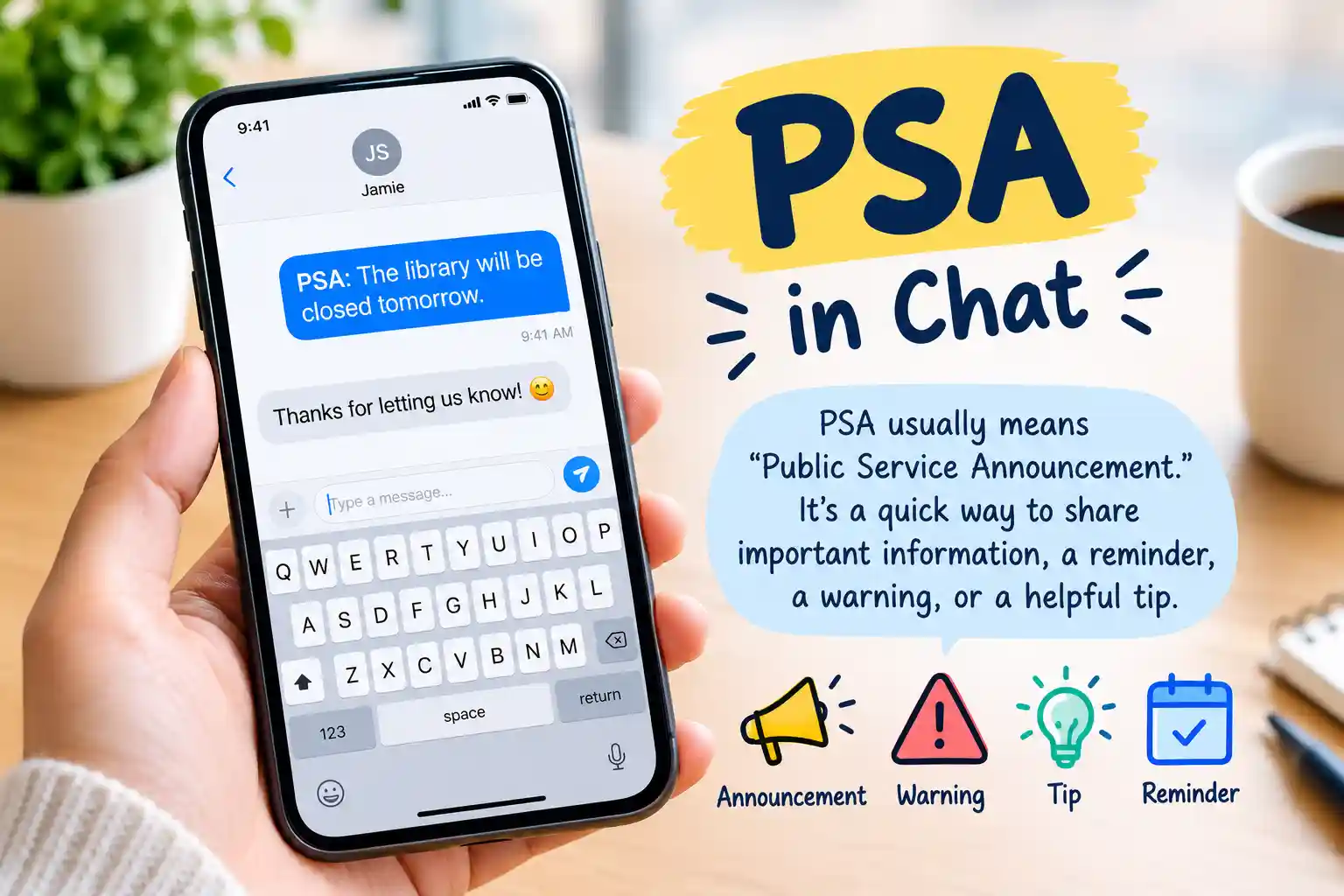
If you see PSA in chat, it usually means Public Service Announcement. People use it to share an important reminder, warning, tip, or piece of information with others.
For example, someone might text, PSA: The store closes early today. In casual messages, social media posts, and group chats, PSA is often a quick way to say, Here is something you should know.
Quick Answer: What Does PSA Mean in Chat?
PSA meaning in chat is usually Public Service Announcement. It is used when someone wants to draw attention to information that may help, warn, or remind other people.
The term originally comes from public announcements made to inform the public about important topics. Today, people use PSA much more casually online.
For example:
PSA: Don’t forget to bring your ID tomorrow.
Here, the person is not making an official announcement. They are simply making sure everyone notices an important reminder.
PSA can appear in text messages, group chats, comments, emails, forums, and social media posts. Its meaning stays mostly the same: Pay attention to this information.
| PSA in chat | Simple meaning |
| PSA | Public Service Announcement |
| PSA meaning | An important notice or reminder |
| PSA in texting | Here is something you should know |
| PSA online | A message meant to inform or remind people |
What Does PSA Mean in Texting?
In texting, PSA is a short way to introduce information that the sender thinks other people should know.
It can be serious, helpful, funny, or even slightly sarcastic. The tone depends on the message that follows it.
For example, a friend might write:
PSA: The coffee shop has a new breakfast menu.
This is simply useful information.
Someone could also write:
PSA: Check your pockets before putting your clothes in the washer.
This sounds like a helpful reminder, possibly based on a personal mistake.
The abbreviation makes the message stand out. When people see PSA, they often expect a quick announcement or useful piece of information.
In modern texting, PSA does not always mean a formal announcement. It is commonly used in a relaxed and conversational way.
What Does PSA Stand For?
PSA stands for Public Service Announcement.
A public service announcement is traditionally a message created to inform the public about an issue, safety matter, health topic, or other important subject.
For example, public organizations may use announcements to encourage people to wear seat belts, avoid dangerous behavior, or prepare for emergencies.
The same idea has moved into everyday online communication. Instead of addressing an entire city or country, a person may use PSA to address friends, followers, coworkers, or members of an online group.
| Term | Meaning | Common setting |
| PSA | Public Service Announcement | Texts, social media, public messages |
| FYI | For Your Information | Emails, chats, work messages |
| BTW | By the Way | Casual texting |
| IMO | In My Opinion | Chats and social media |
| Reminder | Something to help you remember | Texts and group messages |
How Is PSA Used in a Chat?

PSA is usually placed at the beginning of a message. This tells readers that the next part contains information worth noticing.
For example:
PSA: Tomorrow’s meeting starts at 9 a.m.
Or:
PSA: Save your work before restarting your computer.
It can also be used before a personal tip:
PSA: Always check the weather before planning a long outdoor trip.
The abbreviation works especially well in group chats because it quickly gets everyone’s attention.
Sometimes, people use it for something very small:
PSA: The pizza place is closed on Mondays.
This is not a formal public announcement. It is simply a playful way of saying, I have information you might want to know.
PSA Examples in Real Chats
Seeing examples is one of the easiest ways to understand PSA meaning in chat.
Here are some common examples:
Example 1: A reminder
PSA: Please bring your homework tomorrow.
The sender is reminding everyone about homework.
Example 2: A helpful tip
PSA: Put your phone on airplane mode during the flight.
The sender is sharing advice.
Example 3: A warning
PSA: The roads are very icy this morning.
The sender wants others to be careful.
Example 4: A funny message
PSA: Eating the whole bag of chips is not considered a serving.
This uses PSA humorously rather than formally.
Example 5: A group-chat announcement
PSA: Our game night has moved to Saturday.
The sender is making sure everyone knows about a change.
These examples show that PSA can be serious or playful. The main purpose is to make information noticeable.
PSA Meaning on Social Media

On social media, PSA is very common. People often use it when they want followers to notice a useful tip, warning, opinion, or reminder.
For example:
PSA: Always read the return policy before buying something online.
A person may also use PSA before sharing information about a local event, schedule change, common mistake, or everyday tip.
Social media has made PSA more casual than its traditional meaning suggests. You might see it in a post, caption, comment, or short video title.
The basic idea is still the same: the writer wants people to pay attention to the message.
Is PSA Always Serious?
No. PSA can be serious, helpful, neutral, or funny.
The original meaning of Public Service Announcement is connected with important public information. But online users often use the abbreviation in a humorous way.
For example:
PSA: Never go grocery shopping when you are hungry.
This is not a government warning. It is a funny observation that many people can relate to.
Another example is:
PSA: The weekend goes way too fast.
Again, the writer is using PSA as a playful introduction.
The tone comes from the rest of the message. If the information involves safety or an urgent issue, PSA may be serious. If it involves everyday life, it may simply be humorous.
PSA vs. FYI: What Is the Difference?
PSA and FYI can both introduce information, but they are not exactly the same.
FYI means for your information. It usually tells someone something that may be useful or relevant to them.
PSA means public service announcement. It often suggests that the information is important enough for a group of people to notice.
For example:
FYI: The meeting starts at 10 a.m.
This simply provides information.
PSA: The meeting starts at 10 a.m. Please make sure everyone knows.
This sounds more like a general reminder or announcement.
| Abbreviation | Full form | Main purpose |
| PSA | Public Service Announcement | Draw attention to a useful announcement |
| FYI | For Your Information | Give someone information |
| BTW | By the Way | Add a side point |
| IMO | In My Opinion | Share an opinion |
| TTYL | Talk to You Later | End a casual conversation |
There can be overlap, so the exact difference depends on context.
When Should You Use PSA in a Message?
You can use PSA when you want to make an announcement, reminder, warning, or useful tip stand out.
It works well in casual conversations and online spaces.
Good examples include:
PSA: The deadline is Friday.
PSA: Remember to charge your phone before the trip.
PSA: The library will be closed tomorrow.
PSA: Bring a jacket. It is colder than expected.
However, you may not want to use PSA in every situation. If you are writing a formal business letter or official document, spelling out the information directly may sound more professional.
For example, instead of:
PSA: The office will close at 3 p.m.
a formal notice might say:
Please be advised that the office will close at 3 p.m.
The right choice depends on your audience and the tone you want.
Common Mistakes With PSA in Chat
One common mistake is assuming that PSA always refers to an official government or organization announcement.
In casual online communication, that is often not true. A friend can use PSA before a simple reminder.
Another mistake is thinking PSA has only one possible meaning. Abbreviations can have different meanings in different fields and conversations. Context matters.
It is also easy to overuse PSA. If every message starts with PSA, the phrase can lose its impact.
For casual texting, use it when you genuinely want to highlight something.
You should also remember that not everyone knows every abbreviation. If you are talking to someone unfamiliar with internet slang, writing Public Service Announcement the first time can make your meaning clear.
Is PSA Slang or an Acronym?
PSA is best described as an initialism or abbreviation for Public Service Announcement.
In everyday online communication, people often treat it like internet slang because it is frequently used in informal posts and chats.
Unlike some texting abbreviations, PSA did not begin as internet slang. Its original use was connected to public communication. The internet simply gave people a new, more casual way to use it.
Today, you may see PSA in both informal and more serious contexts.
Does PSA Mean Anything Else in Chat?
Usually, when someone writes PSA in a casual chat, they mean Public Service Announcement.
However, abbreviations can have different meanings in specialized settings. For example, PSA can refer to completely different terms in medicine, business, science, or other professional fields.
That is why context is important.
If someone writes:
PSA: Don’t forget your umbrella!
it clearly means a public-service-style announcement or reminder.
If you see PSA in a technical conversation, the meaning may be different.
When you are unsure, look at the words around the abbreviation or ask the person what they mean.
How to Reply to a PSA Message
You usually do not need a special response to a PSA message. Your reply can simply acknowledge the information.
For example:
Thanks for the heads-up!
Good to know!
Thanks for letting me know.
Got it!
If the PSA is funny, you can respond in the same tone:
That is very important information 😂
If the message is a serious warning, a simple acknowledgment is usually better.
The key is to match your response to the message’s tone.
FAQs
What does PSA mean in chat?
PSA usually means Public Service Announcement. In chat, it introduces information, a reminder, warning, tip, or announcement that the sender wants others to notice.
What does PSA mean in texting?
In texting, PSA usually means Public Service Announcement. People often use it casually to say, Here is something you should know.
Is PSA a slang word?
PSA is an abbreviation or initialism rather than traditional slang. However, it is commonly used in casual internet conversations and social media.
Can PSA be used as a joke?
Yes. People often use PSA humorously. For example, PSA: Never go shopping when you are hungry is a playful statement rather than a formal announcement.
What is the difference between PSA and FYI?
PSA means Public Service Announcement and often highlights information for a group. FYI means For Your Information and is generally used simply to provide information.
Should I use PSA in a formal message?
You can, but it may sound casual. In a formal email, report, or business notice, it is often better to state the information directly or use more professional wording.
Conclusion
Understanding PSA meaning in chat is simple: it usually stands for Public Service Announcement.
In everyday texting, people use PSA to introduce information they want others to notice, such as a reminder, warning, helpful tip, or announcement.
The phrase does not always have to be serious. Friends and social media users often use PSA in funny or playful messages, too. The meaning is usually clear from the words that come after it.
If you see a message that begins with PSA, think of it as a quick signal that says, Pay attention this may be useful or important.
When using PSA yourself, keep your audience and tone in mind. It works especially well in casual chats, group messages, and social media posts.

Ali Sher is a writer and the creator of Factnora.com, a website dedicated to sharing fascinating facts, biographies, history, and useful knowledge. He enjoys researching interesting topics and turning them into simple, engaging stories for readers. Through factnora, Muhammad aims to provide informative content that is easy to understand, enjoyable to read, and worth sharing.