La Santa Muerte meaning is Holy Death or Saint Death in Spanish. La Santa Muerte is a Mexican folk-saint figure shown as a female skeleton.
Many devotees connect her with protection, healing, justice, love, work, money, and safety. She is not an officially recognized saint of the Roman Catholic Church.
The image of a robed skeleton can look strange or frightening at first. But the meaning behind La Santa Muerte is more complex than death alone. For many followers, she represents a powerful presence who understands human problems, offers protection, and reminds people that death is part of life.
Her devotion has grown from Mexico to other parts of the world, including the United States. Researchers have studied her history, symbols, prayers, shrines, and the different reasons people turn to her.
Quick Answer: What Does La Santa Muerte Mean?
La Santa Muerte literally means Holy Death or Saint Death. The Spanish word muerte means death, while santa can mean holy or saint. She is usually shown as a female skeleton wearing a long robe.
For many devotees, she is connected with protection, health, love, money, justice, work, and help during difficult times. Her skeleton does not simply mean something evil. Instead, it can represent the fact that death comes to everyone and that people often seek comfort when facing danger, illness, loss, or uncertainty.
| Term | Simple meaning |
| La Santa Muerte | Holy Death or Saint Death |
| Muerte | Death |
| Santa | Holy or saint |
| Common image | Female skeleton in a robe |
| Main setting | Mexican folk religion and popular devotion |
| Catholic status | Not officially recognized as a Catholic saint |
La Santa Muerte Meaning and Symbolism
The meaning of La Santa Muerte can change from one devotee to another. There is no single belief that explains every person’s devotion. Academic research describes a broad range of practices and personal meanings.
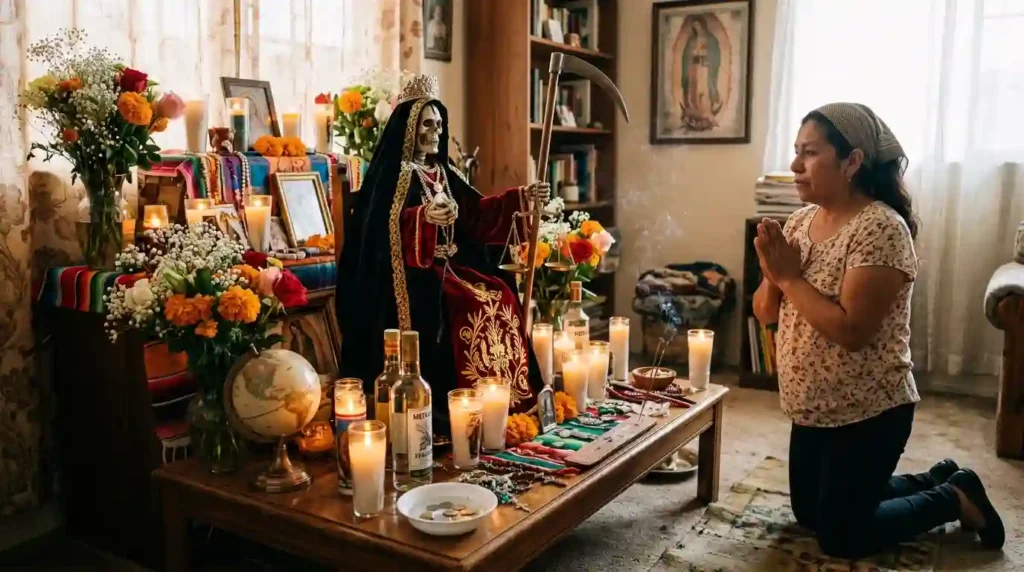
One important meaning is protection. Some devotees turn to Santa Muerte when they feel unsafe or vulnerable. They may keep an image at home, wear a pendant, light candles, or pray at an altar.
Another common meaning is healing and health. Devotees may ask for help during illness or other difficult situations. Research on Santa Muerte devotion has found that health is one of the areas connected with prayers and requests.
She can also represent justice. Some people see her as a figure who treats everyone equally because death eventually comes to all people, regardless of wealth or social position.
Love and relationships are another part of Santa Muerte devotion. Some followers ask for help with relationships, emotional problems, or family concerns.
Money and work also appear in devotional practices. Researchers describe requests related to employment, financial security, and everyday needs. This is one reason Santa Muerte devotion can be understood as a religion of daily life rather than something focused only on death.
| Symbol or theme | Common meaning in devotion |
| Skeleton | Mortality and the reality of death |
| Robe | Spiritual or sacred identity |
| Scythe | Death, change, and the cutting away of problems |
| Globe | Power or influence over the world |
| Scales | Justice and balance |
| Candles | Prayer, devotion, or a personal request |
| Altar | A place for prayer and personal devotion |
These meanings can vary by person, region, and devotional tradition. A symbol should not automatically be given one fixed meaning.
What Does the Skeleton Represent?
The skeleton is the most recognizable part of Santa Muerte’s appearance. It naturally reminds people of death, but death can have several meanings in religious traditions.
For some followers, the skeleton is a reminder that life is temporary. It can encourage people to value the time they have and remember that every person shares the same final destination.
Santa Muerte is also a personification of death. This means an idea that is normally abstract—death—is represented as a person-like figure. The figure is usually female and dressed in robes. The British Museum describes her as a female folk saint and personification of death, often shown with a scythe or globe.
This does not mean every devotee sees her in exactly the same way. Some view her as a saint-like protector, while others understand her more as a spiritual figure connected with death itself.
Where Did La Santa Muerte Come From?
The history of La Santa Muerte is complicated, and there is no single simple origin story accepted by all researchers.
Scholars often describe Santa Muerte as a syncretic figure. Syncretism means that ideas or practices from different religious and cultural traditions come together.
Research connects her imagery with European ideas about death, including the female personification of death known in Spanish tradition as la Parca. Scholars also discuss connections with Indigenous Mexican traditions involving death and the underworld.
Some popular accounts directly identify Santa Muerte with an Aztec goddess such as Mictecacihuatl. However, this should be treated carefully.
Modern devotion became much more visible in Mexico during the late 20th century and grew quickly from the 1990s and especially after 2000. Researchers now study Santa Muerte devotion in Mexico, the United States, and other countries.
Is La Santa Muerte a Catholic Saint?
No. La Santa Muerte is not a canonized Catholic saint.
This distinction is important because the word santa can make people think she has been officially recognized by the Catholic Church. She has not.
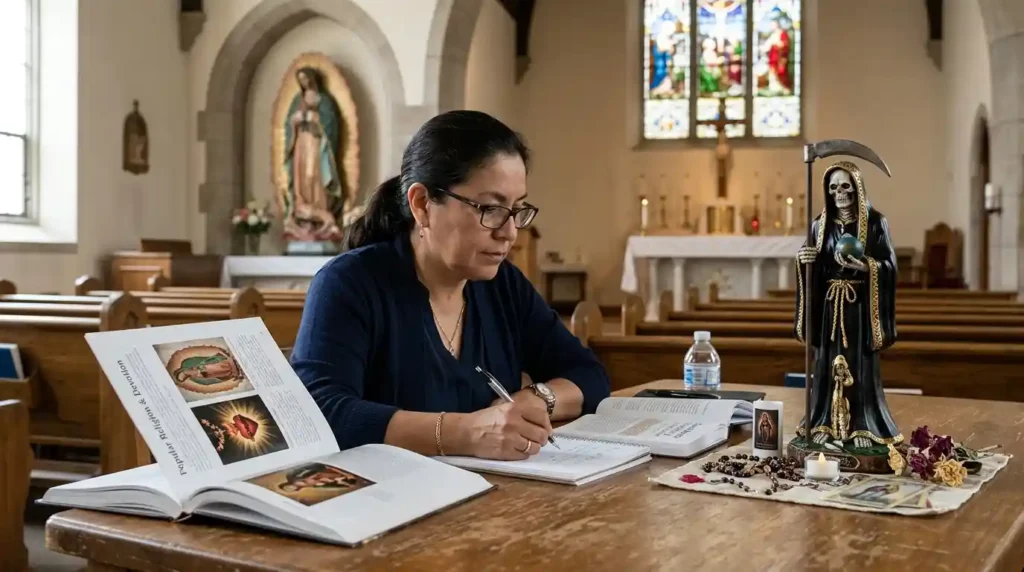
Santa Muerte devotion often uses Catholic-looking elements, including candles, rosaries, prayers, altars, and clothing that may resemble Catholic religious imagery. At the same time, the Catholic Church does not recognize Santa Muerte as a saint and has publicly opposed her veneration.
This creates an interesting difference between official religion and popular religion. A person can use Catholic symbols while also following a folk religious practice that is outside official Catholic teaching.
For this reason, it is more accurate to call Santa Muerte a Mexican folk saint or a figure of popular religion rather than a Catholic saint.
What Do Santa Muerte Colors Mean?
Santa Muerte statues and images often appear in different robe colors. Some devotional traditions give these colors different meanings.
For example, red may be connected with love, while white can be associated with peace or protection. Green may be connected with justice or legal matters, and gold can be linked with money or prosperity.
However, these meanings are not universal rules. Different devotional traditions can assign different meanings to colors.
| Color | Meaning sometimes associated with it |
| White | Peace, protection, purification |
| Red | Love, passion, relationships |
| Green | Justice, legal matters, money |
| Gold | Prosperity and financial success |
| Black | Protection or difficult situations |
| Purple | Spiritual matters or healing |
Because practices vary, it is better to say that these are common associations, not fixed religious laws.
Why Do People Pray to Santa Muerte?
People may turn to Santa Muerte for very personal reasons. Academic research describes devotion connected with health, work, love, justice, security, and other everyday concerns.
For some people, the attraction comes from the idea that Santa Muerte does not represent a perfect or distant world. She represents something everyone understands: death.
This can make her feel close to people dealing with difficult parts of life. Researchers have found that devotees may treat Santa Muerte almost like a family member or trusted spiritual presence. One study of devotion in Mexico City found that followers included people from different parts of society, rather than only criminals or prisoners.
This is important because popular media have often connected Santa Muerte with drug trafficking and violence. Those associations do exist in some settings, but scholars caution against treating them as a complete explanation of the devotion.
Is Santa Muerte Connected to Crime?
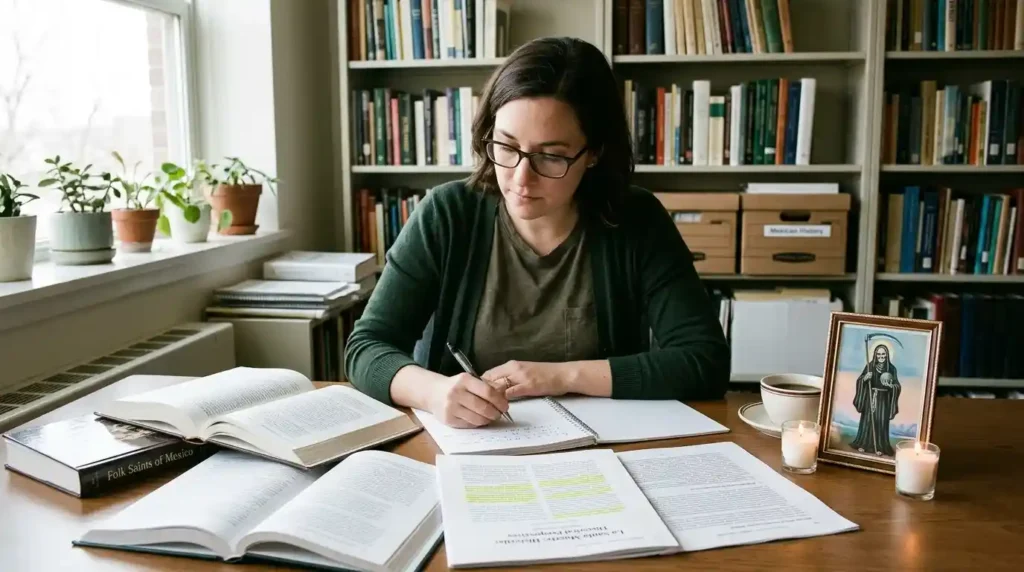
Santa Muerte has been associated with organized crime and drug trafficking in news reports and public discussions. Some criminals have used her imagery, and this has contributed to her reputation.
But that does not mean every devotee is involved in crime.
Academic research has specifically challenged the idea that Santa Muerte devotion can simply be described as a narco religion. Studies have found devotees who seek protection, health, love, work, justice, and family support.
The British Museum also notes the association with marginalized groups, including drug traffickers, while describing Santa Muerte more broadly as a folk saint associated with healing, protection, and safe passage to the afterlife.
So, when you see a Santa Muerte image, its meaning depends on its setting. A statue in a personal home altar may have a very different meaning from an image used by a criminal group.
La Santa Muerte and Day of the Dead
Santa Muerte and Día de los Muertos, or Day of the Dead, are sometimes connected because both use images of death and skeletons.
However, they are not the same thing.
Day of the Dead is a broad Mexican tradition centered on remembering and honoring deceased loved ones. Santa Muerte devotion is focused on a particular spiritual figure.
Santa Muerte imagery also draws on wider Mexican traditions of representing death through skulls and skeletons. Utah State University notes connections between Santa Muerte imagery, calavera traditions, All Souls’ Day, and Day of the Dead imagery.
The similarities can make the two seem identical, but they have different religious and cultural meanings.
What Does Seeing a Santa Muerte Symbol Mean?
If you see a Santa Muerte tattoo, necklace, statue, sticker, or artwork, you should not assume that it has one specific meaning.
The person may connect it with protection, personal faith, mortality, family, justice, healing, or another private belief. Some people may also use the image simply because they find its symbolism powerful.
A tattoo, for example, might represent someone’s acceptance of death or a difficult period they survived. Another person might wear the same image as a devotional symbol.
Context matters more than the image alone.
Common Questions About La Santa Muerte Meaning
What does La Santa Muerte mean in English?
La Santa Muerte means Holy Death or Saint Death in English. It refers to a female skeletal folk-saint figure associated with death and, for many devotees, protection and help in daily life.
Is La Santa Muerte evil?
The answer depends on religious belief and personal interpretation. Some people view Santa Muerte negatively because of her association with death and because some criminal groups have used her image. Devotees, however, may view her as a protector and spiritual figure connected with health, love, justice, work, and security.
Is Santa Muerte a real saint?
She is considered a folk saint, but she is not an officially recognized or canonized Catholic saint. The Catholic Church does not recognize her as a saint and has opposed devotion to her.
What does a Santa Muerte tattoo mean?
A Santa Muerte tattoo can have different meanings. It may represent mortality, protection, devotion, personal survival, justice, or respect for the figure. The exact meaning belongs to the person who chose the tattoo.
What does the Santa Muerte skeleton symbolize?
The skeleton mainly represents death and human mortality. For devotees, it can also represent protection, equality, change, or the acceptance of life’s temporary nature. The exact interpretation can vary.
Why is Santa Muerte dressed like a saint?
Santa Muerte is often shown wearing long robes and religious-looking clothing. This style helps express her sacred or saint-like role within folk devotion. Some images resemble Catholic figures, even though Santa Muerte is not officially recognized by the Catholic Church.
Conclusion
The La Santa Muerte meaning goes far beyond the simple idea of death. Her name means Holy Death or Saint Death, and she is usually shown as a female skeleton wearing a robe.
For many devotees, she represents protection, healing, love, justice, work, money, and support during difficult parts of life.
Her history reflects a mixture of Mexican popular religion, Catholic imagery, European ideas about death, and Indigenous traditions. At the same time, her modern devotion should not be reduced to one simple origin story or to crime.
It is also important to remember that Santa Muerte is a folk saint, not an officially recognized Catholic saint. Her meaning can change depending on the person, community, symbol, and situation.
If you see Santa Muerte in a tattoo, statue, necklace, or altar, look at the surrounding context before deciding what it means. The same image can carry very different personal meanings for different people.

Muhammad Haroon is the founder and writer behind Factnora.com, a platform focused on sharing interesting, useful, and reliable information. His work covers biographies, history, facts, and stories that help readers discover something new in a simple and engaging way. Through factnora, Muhammad aims to make learning enjoyable while presenting information in a clear and reader-friendly style.