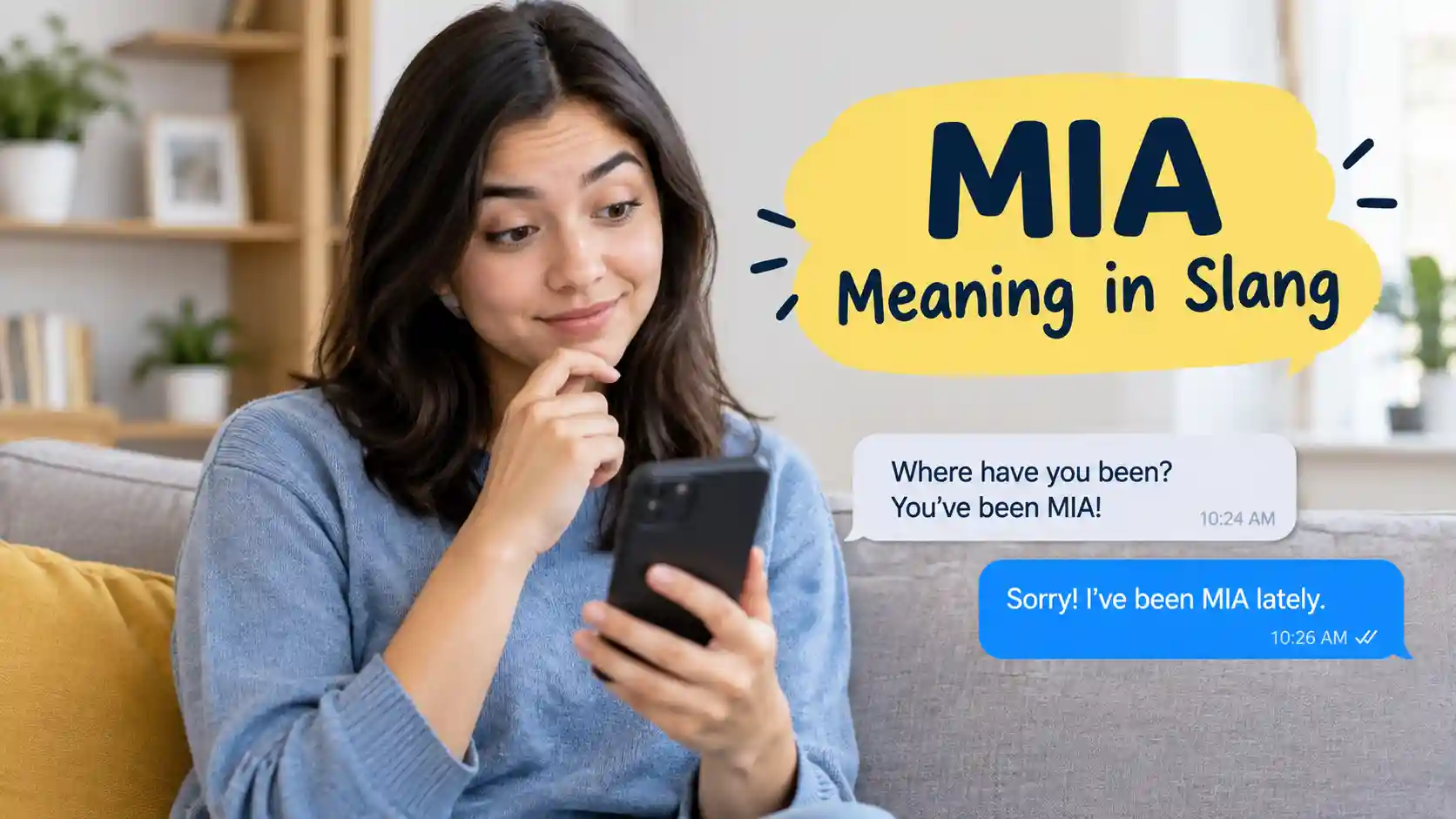
If you see MIA in a text, chat, or social media post, it usually means missing in action In slang, people use MIA when someone has disappeared, stopped replying, or has not been seen for a while.
For example, Where have you been? You’ve been MIA! means the person has been gone or hard to reach. The term is common in casual American English and is often used in texts, captions, and everyday conversation.
In this guide, you’ll learn the MIA meaning in slang, where the expression comes from, how to use it naturally, and what it means in different situations.
Quick Answer
The MIA meaning in slang is missing in action It describes someone who is absent, unavailable, or not responding.
For example:
Sarah has been MIA all weekend
This means Sarah has not been around or has not been responding.
MIA is usually casual. You may see it in text messages, social media posts, online chats, and conversations with friends.
| Term | Meaning | Common use |
| MIA | Missing in action | Someone is absent or unreachable |
| AFK | Away from keyboard | Someone is temporarily away online |
| Ghosting | Suddenly stopping communication | Dating or social situations |
| AWOL | Absent without permission | More formal or serious absence |
The exact meaning depends on the situation, but MIA almost always suggests that someone has been missing or unusually quiet.
MIA Meaning in Slang
In slang, MIA means that a person has suddenly become hard to find or contact.
It can describe someone who has not answered messages, skipped a gathering, disappeared from social media, or simply has not been around lately.
For example:
Tom has been MIA since Monday
The speaker probably means Tom has not replied or been seen since Monday.
Another example is:
Sorry I’ve been MIA.
Here, the speaker is saying they have been unavailable because they have been busy.
The word does not always mean that something is wrong. Often, it is just a light and casual way to say that someone has been absent.
You can also use MIA for things, not just people. For example:
My phone charger has gone MIA
This means the charger has disappeared or cannot be found.
What Does MIA Stand For?

MIA stands for missing in action The phrase has a military background and refers to a service member whose status is unknown after taking part in military action.
In everyday slang, however, the meaning is much less serious. People commonly use MIA as a casual expression for being absent or unavailable.
| Context | What MIA means |
| Texting | Not replying |
| Social media | Not posting or appearing |
| Work | Not available or present |
| Friends | Not showing up or being around |
| Dating | Not responding or suddenly disappearing |
| Everyday life | Something or someone cannot be found |
Because the slang use is informal, the phrase often has a playful tone.
For instance:
You went MIA on us last night!
This could simply mean that a friend left the group or stopped answering messages.
How to Use MIA Correctly
MIA is usually used as an adjective-like slang term after a form of be
Common patterns include:
He is MIA
She’s been MIA lately
I was MIA for a few days
Why have you been MIA?
The phrase go MIA is also common.
Jake went MIA after the meeting
This means Jake disappeared or became unavailable after the meeting.
You can use MIA in casual speech, but it is not the best choice for formal writing. In a business email, for example, unavailable, absent, or out of the office may sound more appropriate.
| Casual | More formal |
| Mike is MIA | Mike is currently unavailable |
| I’ve been MIA | I have been unavailable |
| She went MIA | She became unavailable |
| Where have you been? You’re MIA! | I haven’t heard from you recently |
MIA in Texting and Social Media
MIA is especially common in texting and social media because it is short and easy to understand.
A friend might text:
You’ve been MIA. Everything okay?
Someone might post:
Sorry for being MIA lately!
A social media user could also say:
I’ve been MIA from Instagram
In these examples, MIA simply means the person has not been active or available.
The expression can also be humorous. Someone who takes a long time to answer a text may get a message like:
Hello? You’ve been MIA for three days 😂
The tone depends on the relationship between the people. Among close friends, it may sound playful. In another situation, it could sound like a complaint.
MIA vs. Ghosting, AWOL, and AFK

MIA is similar to several other slang terms, but they are not exactly the same.
Ghosting usually means deliberately ending or avoiding communication without explanation. It is especially common when talking about dating or relationships.
AFK means away from keyboard Gamers and online users often use it when they are temporarily away from their device.
AWOL means absent without leave It also has military roots and can describe someone who leaves without permission. In everyday speech, it can be used jokingly.
MIA is broader. It simply tells you that someone or something is missing, absent, or unavailable.
| Expression | Main idea | Example |
| MIA | Absent or unavailable | Lisa has been MIA |
| Ghosting | Stopping communication without explanation | He ghosted me |
| AFK | Temporarily away from a device | I’m AFK for 10 minutes |
| AWOL | Absent without permission | He went AWOL from the office |
These terms can overlap, but replacing one with another can change the meaning.
Real-Life Examples of MIA
Seeing MIA in complete sentences makes the slang easier to understand.
If a friend has not answered your messages, you might say:
You’ve been MIA all day
If someone has stopped posting online, you could say:
She’s been MIA on social media lately
If you have been very busy yourself, you might write:
Sorry I’ve been MIA. I had a lot going on
MIA can also describe missing objects:
My keys have gone MIA again
In this case, the keys obviously cannot reply to messages. The speaker is simply using MIA humorously to say the keys have disappeared.
You can even use the expression for events or activities:
Pizza night has been MIA lately
That means pizza night has not happened recently.
Common Mistakes With MIA
One common mistake is assuming that MIA always means someone is ignoring you on purpose. It does not.
If someone says, I’ve been MIA, they may simply have been busy, traveling, tired, sick, or away from their phone. The expression does not automatically mean they were intentionally avoiding anyone.
Another mistake is using MIA in a very formal setting. The expression is casual slang, so it may sound too informal for official documents.
It is also important to remember that MIA can have a serious military meaning. The casual slang meaning is different from the original military context.
Finally, avoid assuming that every use of MIA has the same emotional tone. Context matters. My keys are MIA is usually playful, while He has been MIA for weeks may express concern.
Is MIA Formal or Informal?
MIA is informal. It works well in conversations, text messages, social media, and casual emails.
For formal writing, use clearer words such as absent, unavailable, away, or not reachable, depending on the situation.
For example, instead of writing:
The manager is MIA today
A workplace message might say:
The manager is unavailable today
That sounds more professional and gives the reader a clearer idea of the situation.
Still, MIA is widely understood in casual American English, so there is nothing unusual about seeing it in everyday communication.
British vs. American English

The slang use of MIA is understood in both American and British English. However, the expression is especially common in informal online communication, where short forms and abbreviations are widely used.
Someone in the United States or the United Kingdom may say:
You’ve been MIA!
The meaning remains the same: the person has been absent or difficult to contact.
The main difference is not the meaning but the situation and personal speaking style. Because MIA is informal, some people may prefer words such as away, missing, or unavailable in more formal settings.
FAQs
What does MIA mean in texting?
In texting, MIA usually means missing in action It means someone has been absent, has not replied, or has been difficult to reach.
What does you’ve been MIA mean?
You’ve been MIA means you have been missing or unavailable It is often said when someone has not called, texted, visited, or appeared online for a while.
Is MIA a bad word?
No. MIA is not a bad word or a swear word. It is a casual abbreviation. However, the tone can depend on the situation. It can be friendly, funny, or slightly critical.
Can MIA describe an object?
Yes. People sometimes use MIA humorously for objects that cannot be found. For example, My sunglasses are MIA means the speaker cannot find their sunglasses.
Is MIA the same as ghosting?
Not exactly. MIA means someone is absent or unavailable. Ghosting usually suggests that someone has stopped communicating without explanation, often intentionally. A person can be MIA without ghosting anyone.
Can I use MIA in a work email?
You can, but it is usually better for casual workplace communication. In formal business writing, words such as unavailable, absent, or out of the office are clearer and more professional.
Conclusion
The MIA meaning in slang is missing in action In everyday English, it usually means that someone is absent, unavailable, or has not been responding.
You may see it in texts, social media posts, chats, and casual conversations. For example, You’ve been MIA! simply means that someone has not been around or easy to reach.
MIA can also describe missing objects in a playful way, such as My keys are MIA Remember that the term is informal, so choose more formal words like unavailable or absent in professional writing.
When you see MIA in a message, use the surrounding context to understand the exact tone and meaning.

Muhammad Haroon is the founder and writer behind Factnora.com, a platform focused on sharing interesting, useful, and reliable information. His work covers biographies, history, facts, and stories that help readers discover something new in a simple and engaging way. Through factnora, Muhammad aims to make learning enjoyable while presenting information in a clear and reader-friendly style.