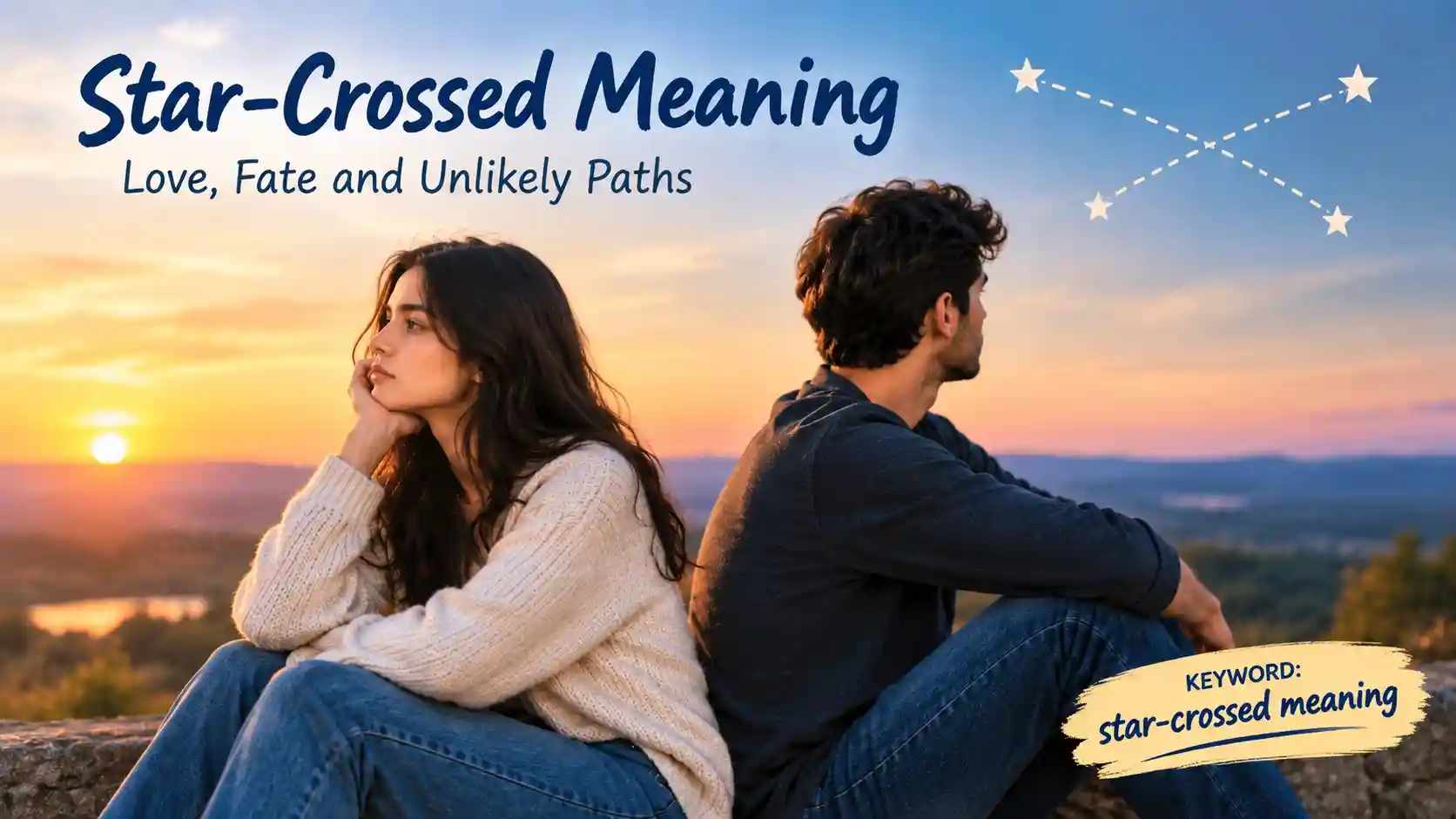
Have you ever heard someone call two people star-crossed and wondered what it means? The star-crossed meaning describes people whose relationship seems blocked by fate, bad luck, or circumstances beyond their control.
The phrase is often used for lovers who care deeply for each other but face serious obstacles that keep them apart. It can also describe people or events that seem destined for trouble.
The expression is closely linked to William Shakespeare’s Romeo and Juliet, where the main characters are famously described as star-crossed lovers.
Today, however, the phrase is used in many situations beyond the famous play. In this guide, you will learn the simple definition, origin, examples, correct usage, common mistakes, and related expressions.
Quick Answer: What Does Star-Crossed Mean?
Star-crossed means affected by unlucky circumstances or fate, especially when two people love each other but cannot easily be together.
For example, you might say, They were star-crossed lovers because their families were against their relationship.
The word suggests that the stars, fate, or forces outside the people’s control are working against them. It does not simply mean that a relationship is difficult. It often carries the idea that the people may have little control over what happens.
| Term | Simple meaning |
| Star-crossed | Unlucky or blocked by fate |
| Star-crossed lovers | Lovers facing powerful obstacles |
| Fate | Events believed to be beyond personal control |
| Forbidden love | Love that is not accepted or allowed |
The phrase is usually connected with romance, but it can sometimes be used more broadly.
Star-Crossed Meaning in Simple English

In simple English, star-crossed means unlucky because of circumstances or fate.
Imagine two people who truly love each other. They want to be together, but their families strongly oppose the relationship. Or perhaps they live in different countries, meet at the wrong time, or face a situation that keeps pulling them apart.
Someone might describe them as star-crossed lovers.
The idea comes from an old belief that the stars could influence human lives. If a person’s stars were thought to be unfavorable, that person might experience bad luck or difficult events.
Today, most people do not use star-crossed literally to say that stars control someone’s life. Instead, it is usually a poetic way to describe a relationship or situation that seems doomed by circumstances.
The word can therefore carry a feeling of romance, sadness, struggle, and fate all at once.
What Are Star-Crossed Lovers?
Star-crossed lovers are two people who love each other but face major barriers that make their relationship difficult or impossible.
This expression is especially famous because of Shakespeare’s Romeo and Juliet. Romeo and Juliet come from families that are enemies. Their love develops despite this conflict, creating a relationship surrounded by danger and tragedy.
The phrase does not necessarily mean that the couple does something wrong. Instead, the problem may come from outside forces.
For example, a couple might be called star-crossed because:
They come from families that refuse to accept their relationship.
They live far apart and cannot remain together.
Their lives take different paths at an unfortunate time.
Social or cultural barriers separate them.
A serious conflict prevents them from being together.
They repeatedly experience circumstances that work against their relationship.
Here is a simple comparison:
| Expression | What it suggests |
| In love | Two people have romantic feelings |
| Forbidden love | Their love is not accepted or allowed |
| Star-crossed lovers | Their love faces powerful, often fate-like obstacles |
| Unlucky couple | The couple experiences bad luck |
| Doomed relationship | The relationship seems likely to fail |
Not every difficult relationship is automatically star-crossed. The expression usually has a stronger sense of fate, misfortune, or circumstances beyond the couple’s control.
Where Did the Phrase Star-Crossed Come From?
The phrase star-crossed is strongly associated with William Shakespeare’s Romeo and Juliet, written in the late 16th century.
At the beginning of the play, Romeo and Juliet are described as star-crossed lovers. This famous phrase introduces the idea that their relationship is affected by forces working against them.
The expression reflects an older belief in astrology. For centuries, some people believed that the positions of the stars and planets could influence a person’s personality, future, luck, or important life events.
The exact history of the idea is older than Shakespeare, but Romeo and Juliet helped make the phrase especially well known in English.
| Source or idea | Connection to star-crossed |
| Astrology | Stars and planets were traditionally linked with human fate |
| Shakespeare | Popularized the phrase through Romeo and Juliet |
| Romeo and Juliet | Provides the classic example of star-crossed lovers |
| Modern English | Uses the phrase mainly in a figurative way |
Today, you do not need to believe in astrology to use the expression. It is commonly understood as a literary or figurative phrase.
How to Use Star-Crossed in a Sentence
Star-crossed is normally used as an adjective. It describes a person, relationship, romance, or situation affected by bad luck or difficult circumstances.
For example:
Romeo and Juliet are famous as star-crossed lovers.
The movie tells the story of two star-crossed teenagers.
They seemed like a star-crossed couple from the beginning.
The novel follows a star-crossed romance between two people from rival families.
Our plans were star-crossed by one problem after another.
The phrase is most natural when the situation involves obstacles that feel unusually powerful or difficult to avoid.
It can also appear before a noun, as in star-crossed lovers or a star-crossed romance.
You would usually not use it for a small everyday problem.
For instance, if two friends cannot meet because one is stuck in traffic, calling them star-crossed would sound dramatic or humorous rather than ordinary.
Star-Crossed vs. Doomed: Are They the Same?

The words star-crossed and doomed can have similar meanings, but they are not exactly the same.
Doomed suggests that something is likely to fail or end badly. Star-crossed focuses more on the obstacles, bad luck, or fate that seem to cause the problem.
Consider these examples:
Their relationship was doomed.
This suggests that the relationship was unlikely to succeed.
They were star-crossed lovers.
This suggests that outside forces, fate, or unfortunate circumstances stood between them.
The second expression often sounds more poetic and romantic.
| Word | Main idea | Tone |
| Star-crossed | Fate or circumstances create obstacles | Poetic |
| Doomed | Failure seems unavoidable | Strong |
| Unlucky | Bad things happen by chance | Casual |
| Forbidden | Something is not allowed | Direct |
| Tragic | Events involve great sadness or suffering | Dramatic |
Because of its connection with Shakespeare, star-crossed often sounds literary.
Common Examples of Star-Crossed
The phrase can appear in books, movies, conversations, and descriptions of fictional relationships.
A classic example is a couple whose families are enemies. They love each other, but family conflict keeps them apart.
Another example could be two people who meet and fall in love while living on opposite sides of the world. They try to make the relationship work, but distance and circumstances repeatedly interfere.
The phrase can also be used outside romance in a creative way.
For example, someone might describe two business partners as star-crossed if their partnership repeatedly suffers from unexpected problems. This use is less common but understandable.
Here are some natural examples:
Everyone thought they were star-crossed lovers.
The story follows a star-crossed romance between two rival families.
They met at the perfect moment, but their lives soon became star-crossed.
Their star-crossed relationship became the center of the novel.
The two teams seemed star-crossed after one setback followed another.
These examples show that the expression is flexible, but romance remains its most familiar use.
Common Mistakes With Star-Crossed
One common mistake is thinking that star-crossed simply means romantic. It does not.
A happy couple who has a healthy relationship is not necessarily star-crossed. The phrase normally suggests conflict, bad luck, fate, or serious obstacles.
Another mistake is assuming that the expression always refers to people. While relationships are the most common example, star-crossed can describe other situations in a figurative way.
Some writers also use the phrase when they really mean forbidden. The two ideas overlap, but they are different.
A forbidden relationship is one that is not allowed or accepted. A star-crossed relationship may be blocked by many different forces, including distance, family conflict, timing, social pressure, or unfortunate events.
It is also worth remembering that star-crossed is usually figurative in modern English. Most speakers are not making a literal claim about astrology.
Is Star-Crossed Positive or Negative?
The phrase usually has a sad or negative meaning, but it can also sound romantic and poetic.
When someone calls a couple star-crossed, they often mean that the couple faces painful obstacles. The phrase can make their story sound dramatic or tragic.
However, it does not necessarily mean that the people do not love each other. In fact, strong love is often an important part of the idea.
For example:
They were star-crossed lovers, but they never stopped caring for each other.
Here, star-crossed describes the difficult circumstances rather than the strength of their feelings.
The expression can therefore combine two ideas: deep affection and serious obstacles.
Why Do People Say Star-Crossed Lovers?

People use star-crossed lovers because the phrase gives a short, memorable way to describe love that faces forces outside the lovers’ control.
Instead of saying:
They love each other, but many difficult circumstances keep them apart.
A writer can simply say:
They are star-crossed lovers.
The phrase is especially useful in literature, movies, stories, and dramatic conversations because it creates a strong image.
It also connects romance with the old idea of fate. The lovers may choose each other, but circumstances seem to have another plan.
That is why the phrase has remained familiar long after Shakespeare first used it.
FAQs
What does star-crossed mean?
Star-crossed means affected by bad luck, fate, or difficult circumstances. It is often used for people whose romantic relationship faces serious obstacles.
What are star-crossed lovers?
Star-crossed lovers are two people who love each other but face powerful barriers that make being together difficult or impossible.
Is star-crossed a romantic word?
It can be. The phrase is strongly associated with romantic relationships, especially relationships that face sadness, conflict, or obstacles.
Does star-crossed mean doomed?
Not exactly. Both words can suggest a difficult outcome, but star-crossed emphasizes fate or outside circumstances, while doomed suggests that failure is likely or unavoidable.
Is star-crossed from Romeo and Juliet?
The phrase is strongly associated with Shakespeare’s Romeo and Juliet, where Romeo and Juliet are famously described as star-crossed lovers. The underlying idea of stars influencing fate is older than Shakespeare.
Can star-crossed be used outside relationships?
Yes. It can be used creatively for other people, plans, or situations that seem repeatedly affected by bad luck or difficult circumstances. However, romantic use is the most common and recognizable.
Conclusion
The star-crossed meaning is simple: it describes someone or something affected by unlucky circumstances, fate, or obstacles that seem beyond personal control.
The phrase is especially common when talking about star-crossed lovers, or people who deeply care for each other but cannot easily be together.
Its strong connection to Shakespeare’s Romeo and Juliet has made it one of the best-known poetic expressions for difficult love.
Still, you do not need to be discussing Shakespeare to use it. In modern English, star-crossed can describe any situation that seems to be working against the people involved.
If you use the phrase, remember its key idea: love or a goal meets powerful circumstances that stand in its way.

Muhammad Haroon is the founder and writer behind Factnora.com, a platform focused on sharing interesting, useful, and reliable information. His work covers biographies, history, facts, and stories that help readers discover something new in a simple and engaging way. Through factnora, Muhammad aims to make learning enjoyable while presenting information in a clear and reader-friendly style.